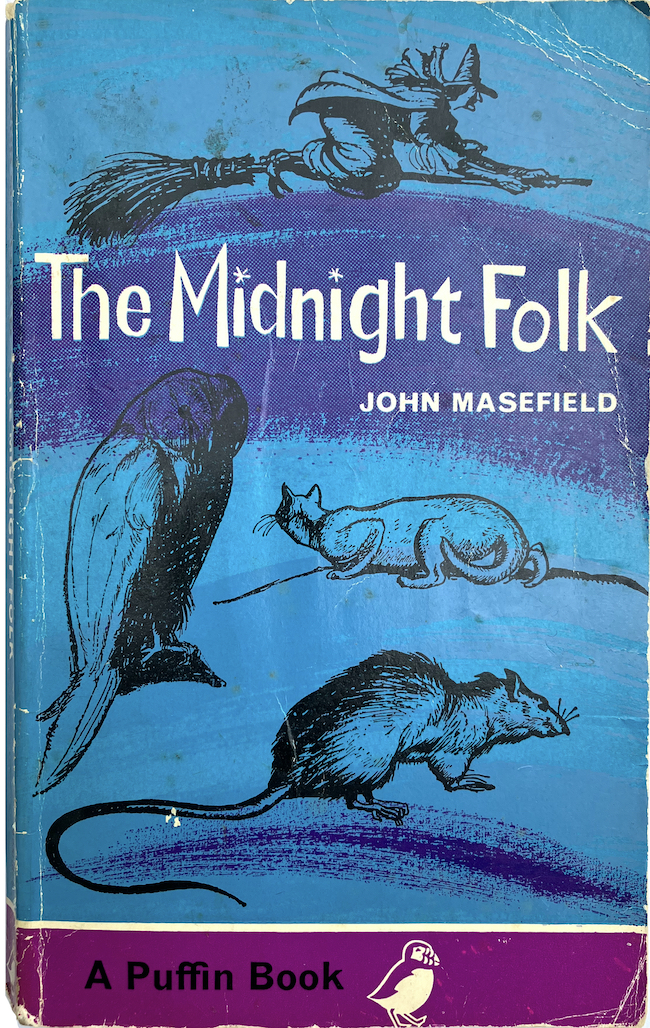
John Masefield was in his last year as Poet Laureate when I was born in 1966. I remember copying out his poem ‘Cargoes’ in primary school – “Quinquireme of Nineveh from distant Ophir . . .” – and wondering what all these strange, beautiful-sounding words meant as I laboured over my ascenders and descenders. That John Masefield, stiff and distant, seemed already to be from a long-dead past.
So it came as a shock to discover that he was the same John Masefield who wrote The Midnight Folk, which seemed to burst from its pages in a torrent of surprises and delights. It was – and is – one of my favourite books. But, while the sheer joy of it is undimmed, I can now see that it stayed in the memory because it is full of deep feelings, and the ultimate resolution of its plot has an emotional satisfaction that I felt as a child but did not then understand.
First published in 1927, The Midnight Folk is still in print; but it is less well known than its sequel, The Box of Delights, which many remember from a successful BBC TV adaptation in the 1980s. Set in the 1890s, its premise is the staple of much children’s literature: a lonely young child, in this case a boy named Kay Harker, has lost his parents and is being brought up by an indifferent guardian and a cruel governess.
Kay’s great-grandfather, Captain Harker, in whose house Kay lives, lost some treasure – ‘church ornaments, images, lamps, candlesticks, reliquaries, chalices and crosses of gold, silver and precious stones’ – entrusted to his care by the archbishop of a South American port during the revolutions and uprisings of 1811. The loss haunted the captain until his death, a haunting that also ruined the happiness of his wife and son. Now others more avaricious than Kay are on the treasure’s trail. Can he find it before they do? It is only at the end that you realize the book is about the restoration of more than one kind of treasure.
 Mathew Lyons