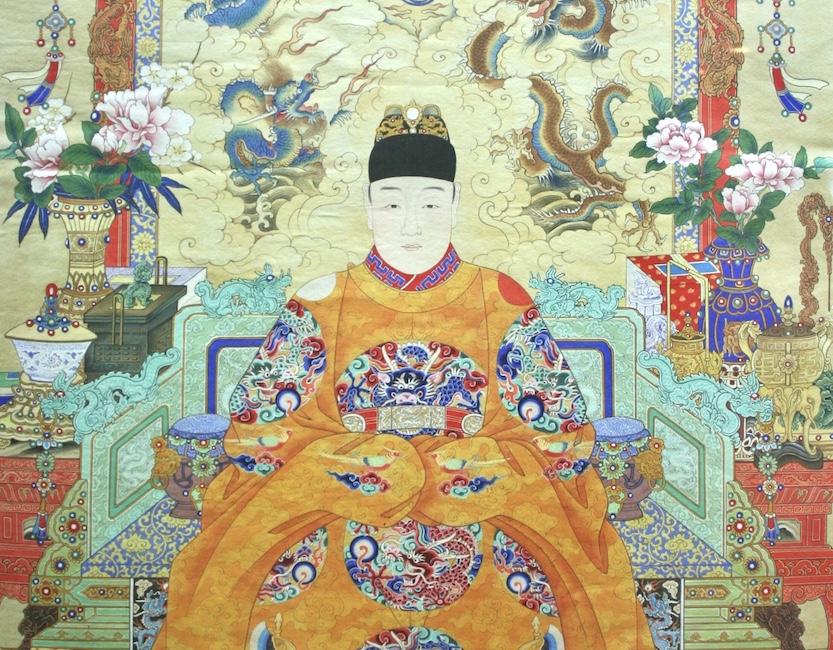
Zhu Youjian, known as the Chongzhen Emperor, was the last of the Ming dynasty to rule China. He came to the imperial throne of China in October 1627 aged 16, on the death of his older brother. As crown prince he had dreamt of seeing a black dragon coiled around a pillar in the palace, an auspicious omen.
But the times were far from good. His reign was plagued with threats, from a series of famines in the 1630s and early 1640s, to rebellions in Shaanxi, Huguang and Henan provinces and incursions by the Manchu from the north.
On 8 February 1644, a rebel warlord named Li Zicheng proclaimed the foundation of his own Shun dynasty, in Xi’an, 500 miles south west of Beijing. A week later he set out with an army for the capital.
Beijing’s granaries and the imperial treasury were alike empty. On 10 February, Chongzhen was advised to flee Beijing. After two months of debate and indecision, he chose to stay. The same day, imperial astronomers reported the pole star, the emperor’s personal symbol, had fallen in the skies. Chongzhen disregarded the omen.
On 23rd April, Li Zicheng’s army had reached the city suburbs. The following day, they were at the gates. That night, Chongzhen drank heavily and rampaged through the palace with a sword, killing his favourite concubine and one of his daughters. He severed the arm of another daughter in a failed attempt to kill her too. She was likely warding off the blow. His empress committed suicide – at his behest.
Chongzhen himself then made a failed attempt to flee the city dressed as a commoner; he was driven back to the palace by his own soldiers, who mistook him for a spy.
When the bell rang the next morning for Chongzhen’s pre-dawn meeting with his advisers, none came. “My ministers have failed me,” he said. “An empire [that has] lasted 277 years; lost in one day.” After dawn, dressed in a blue silk robe with red trousers, he left the palace and climbed to the summit of a place named Meishan, or Coal Hill. There he strangled himself with a sash. When his body was discovered three days later it is said two characters, written in his hand, were found beside him: T’ien-tzu, ‘son of heaven’.
Li Zicheng entered the city later that day. His own empire would last six weeks.
This is an extended version of a piece that first appeared in the February 2023 issue of History Today.
Like this? You can read more of Mathew’s History Today Months Past pieces here.
 Mathew Lyons
Leave a comment