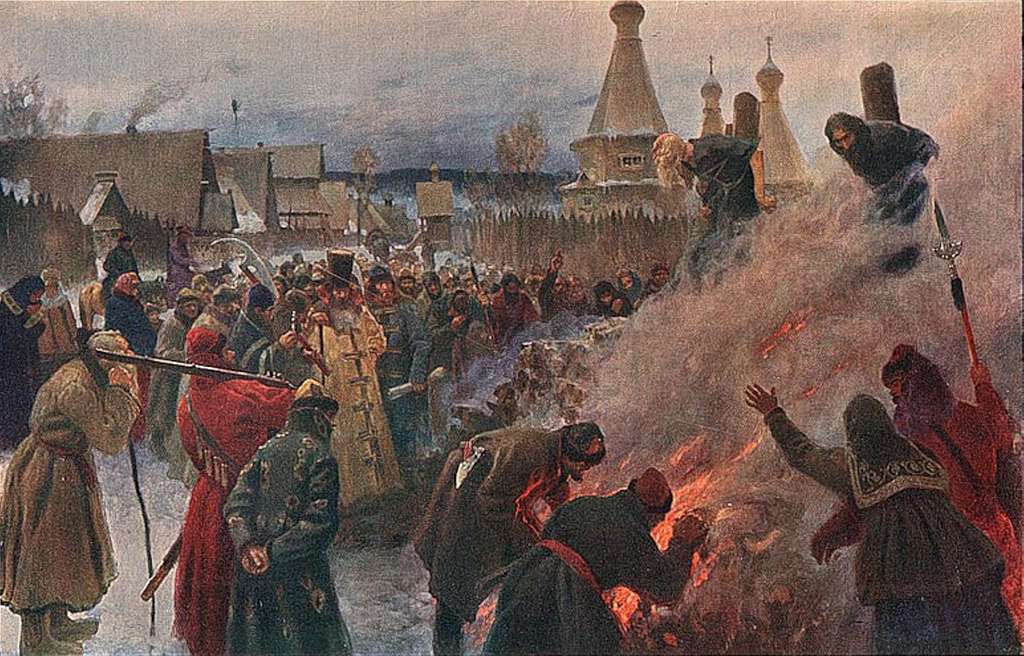
The Archpriest Avvakum Petrov spent the last fourteen years of his life in a pit in Pustozersk, high above the Arctic Circle. Born around 1620 in a small village in Nizhny Novgorod, he had become a leading figure among the Old Believers in the schism that split the Russian church in the 17th century.
Patriarch Nikon, with the support of Tsar Alexis, wanted to align Russian Orthodox practice with the Greek church. He revised liturgy in the 1650s, making what may seem to us like minor changes – using three fingers to make the sign of the cross rather than two, for example – but which proved to be incendiary.
It was opposition to these reforms that earned Avvakum his first term of exile, this time to Siberia. While we might look for analogies with the reformation of the western church, the comparison is inexact; Old Believers like Avvakum often preached in the vernacular, rather than Church Slavic, for instance.
There was a widespread sense of destiny that was both spiritual and nationalistic. It was embodied in the chiliastic myth of the white cowl, said to have been given by Constantine to the pope in Rome, from whence it travelled to Constantinople after the Great Schism between the western and eastern churches, and then, after Constantinople’s fall, to Russia. In this schema, Moscow was a third Rome, ready to lead the Christian world.
Tsar Alexis pushed reform with the aim of uniting the orthodox world, with Moscow at its head; the Old Believers opposed because they believed Russian rites both more authentic and superior.
Avvakum continued to write and propagandise from Pustozersk. Among works written there was his autobiography, sometimes hailed as an avatar of 19th century Russian literature. Tolstoy said he couldn’t read it without weeping; one recent critic has described its authorial voice as “almost spookily modern”.
Eventually the authorities tired of his challenges. On April 14 1682, they burned him alive.
This is a slightly extended version of a piece that first appeared in the April 2023 issue of History Today.
Like this? You can read more of Mathew’s History Today Months Past pieces here.
 Mathew Lyons
Leave a comment