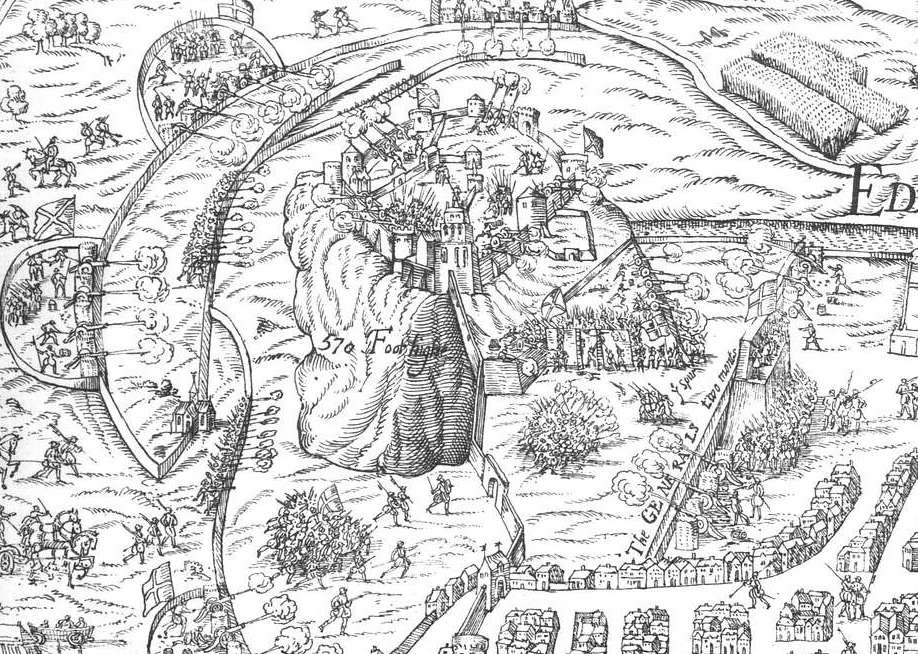
The death of James IV at the battle of Flodden in September 1513 was a catastrophe for his country. He left behind the one-year-old James V to take the throne, and, as regent, his English wife Margaret Tudor, sister of Henry VIII, whose army had just deprived the nation of its king.
Within a year, Margaret had married Archibald Douglas, the earl of Angus, a move that cost her the regency. In her place, the king’s council summoned John Stewart, second duke of Albany, the heir to the throne, back from France, where he had spent much of his life. But Albany returned to France in 1517; Scotland wouldn’t see him again until 1521. In his absence, the council was dominated by James Hamilton, the earl of Arran, the third in line to the throne. Arran and Angus vied for control of both Edinburgh and the infant king.
Things came to a head in April 1520. The capital was in Arran’s hands. On the 29th, Angus approached with some 400 men seeking access to his wife in the castle. Arran, thinking his rival had too few men to defend himself, planned to seize him. The following day, Angus arrayed his men for battle at the Netherbow gate. Angus’s uncle, the bishop of Dunkeld, better known to posterity as the poet Gavin Douglas, tried to mediate; relatedly, perhaps, Douglas had a low opinion of his nephew, describing him as a ’young wytless fuyll’ in a letter to Cardinal Wolsey. Douglas went to see James Beaton, archbishop of Glasgow, chancellor of Scotland – and uncle of Arran’s wife – who was in the church of the Blackfriars. According to the 16th-century historian Robert Lindsay of Pitscottie, when Douglas asked Beaton to intervene, the latter denied any knowledge of the stand-off, thumping his chest for dramatic effect.
Unfortunately, the gesture meant that Douglas heard the sound of plated-metal under the chancellor’s robes. “I persaue, me lord, zour conscience be not goode for I heir thame clatter,” Douglas said. It’s a scene absent from another 16th-century account by George Buchanan; but even Buchanan describes how Beaton “ flew armed up and down like a fire-brand of sedition” instead of seeking peace.
Pitscottie then has Douglas beseeching Arran’s half-brother, Sir Patrick Hamilton of Kincavil to ensure Angus’s safe passage to the castle and back. Arran agreed, but his illegitimate son, Sir James Hamilton – “that bluddie bouchour ewer thristand for blude” as Pitscottie describes him – turned on Sir Patrick and accused him of cowardice. Sir Patrick exploded – “grewit and brunt in anger as fire” – and replied: “Bastard smaike thou lies fallslie, I sall fight this day quhair thou dar not be sene”.
Sir Patrick stormed out in a terrible rage intent on proving his honour. He roused Arran’s men and led them up Blackfriars Wynd towards the Netherbow; he was one of the first to fall. Angus’s force surged up the street, killing Arran’s soldiers as they came out of the narrow passages, forcing those behind back until they fell over one another trying to outrun the slaughter. Beaton ran to the sanctuary of the Blackfriar’s church. Angus’s men dragged him out from behind the altar and ripped his vestments off. It was only the intervention of Gavin Douglas that saved his life.
It was a rout. Arran and his hot-headed son fled, escaping across the North Loch marshes on the back of a collier’s pony. The defeat came with “with greater ignominy than loss” Buchanan says, who reckoned they left 72 dead behind them. Pitscottie put the number over 300.
The city was Angus’s again. The people remembered the stramash as ‘cleanse the causeway’ – ‘clenze calsay’ in the Scots of the day – for what they did to clear the streets of filth.
As for James IV, his body was brought south to Sheen Priory, where it remained in a lead coffin, unburied. After the dissolution the house came to Duke of Suffolk. The historian John Stow, visiting some time later, saw the coffin there “thrown into a waste room amongst the old timber, lead, and other rubble”. Stow reported that workmen later broke into the coffin and cut off the king’s head for their own amusement. The queen’s glazier then took it home to his house in Wood Street, where he enjoyed the sweetness of its scent, before it was eventually buried in an unmarked spot at nearby St Michael’s. What became of the rest of James IV is unrecorded.
This is a slightly extended version of a piece that first appeared in the April 2023 issue of History Today.
Like this? You can read more of Mathew’s History Today Months Past pieces here.
 Mathew Lyons
Leave a comment