In the summer of 1992, Gloria Davey discovered an old ruined church near Swaffham in Norfolk. It had no roof, no windows, no door. Satanists were using it for their rites: inverted crosses daubed the walls, a pentagram the floor. A grave had been opened, giving up its bones. Gloria’s husband Bob, who before retirement worked in a sewage plant, felt himself called to act. He disrupted their rituals. When they threatened to kill him, he called in some notably secular help in the form of soldiers from the local Territorial Army. They didn’t bother him again.
Bob Davey was seventy-three when Gloria discovered the late 11th-century church St Mary the Virgin; he died aged ninety-one in 2021 having visited it every day since. He and a small group of friends built a mile-long access road, made the church watertight again – made the church good again, you might say. He issued an amnesty for those of its effects that had been repurposed for local homes and gardens over the years: the font, the floor tiles, the parish chest, and so on. Then a kind of miracle happened: he discovered, hidden beneath the white plaster, some sacred art. St Mary’s contained the oldest known depiction of the Last Judgement in England, and the only known one of Noah’s Ark.
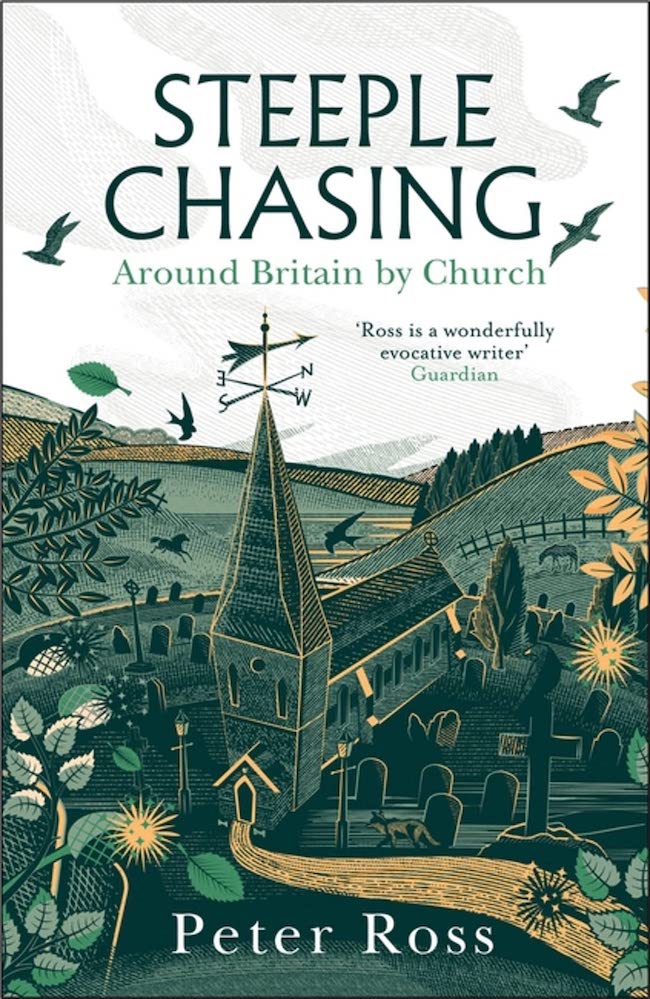
There are some 10,000 surviving medieval churches in England alone. They clearly need us. But, asks Peter Ross, in Steeple Chasing, his profoundly delightful new book, do we still need them? And if so, how?
Steeple Chasing is an extended exercise in what John Betjeman called ‘church crawling’. Ross has visited churches across the United Kingdom in his quest. His principal interest is the medieval church estate. But he extends his remit further to include other kinds of places in which people have anchored meaning: the Angel of the North, say, or the White Spring in Glastonbury. “I basically like to hang out wherever God hangs out,” one of the founders of the latter, tells him. “Be that a church, a cave…, a crazy old water reservoir, or out in nature in the woods.” Church attendance is in decline, Ross notes; yet cathedral visitor numbers are booming. Perhaps these days people want to worship differently; perhaps they don’t even want to call it worship anymore. “You pray as you can, not as you can’t,” a monk at Pluscarden Abbey tells him.
It is human, in other words, to make places and processes sacral. Churches, by virtue of centuries of such work, are the most profoundly human places we can be: hands hewed the stone, bent the iron, cut the glass; the very walls and woodwork are steeped in decade after decade of prayer and song. “Break open a piece from an old church wall,” Ross writes, “and you might find joy and grief spiralling, ammonite-like, through the stone.”
We are suspicious, these days, of the old creaking authority of the church. But churches themselves are different. They may not be places that we go to seek answers any more; but they are still places we go to make peace with the questions. They speak a different language to that of faith – a language beneath language, that language itself can only gesture towards – while still embodying the idea of faith itself, that intrinsically human quality. “A church is a sacrament of stone,” an elderly priest tells Ross. “It absolutely points at things of God, much more than a priest does in his sermon.”
Churches, then, confront us with something ineffable we instinctively recognise, even if we no longer call it the divine; but they also confront us, in their silence, with the challenge of our own bare unbridled selves. And these are particularly challenging times. Ross began the book in 2020, “tired of the present… losing faith in the future… [wanting] to delve into our deep past, to be buttressed and braced by history”. Covid’s shadow hangs over his travels: the fear of it, the dread, the loneliness. But there is a wider sense of frailty. This is “Rickety old Britain,” Ross writes, “one hard wind from the fall.” There are other shadows too: war in Ukraine, migrant crossings, environmental catastrophe. Do churches still have something to offer people – perhaps a nation, a culture – in crisis?
At a material level, the answer is yes. There was something cheering, Ross writes, about places of worship being used as vaccination centres. “To witness the act of vaccination was an epiphany.” Late in the book he visits London’s St Martin-in-the-Fields, which ministers to the capital’s homeless migrants, “the least and the last and the lost”. It is an old Christian duty but St Martin’s has taken it to heart for decades. The Royal Mail once had to process a letter addressed to ‘God, somewhere in the world’; they delivered it to St Martin-in-the-Fields.
Is the absence of God a problem, though? Many of Ross’s interviewees, most of them elderly, have lost their faith somewhere along the way. Ross himself has mislaid the Catholicism he was born into. Faith, on this account, is not binary though. Steeple Chasing is, among other things, a love letter to “people who lose their hearts to lost causes”, in this case, the small army of often elderly volunteers who keep living churches active and bring abandoned ones back from the dead, who keep faith in the faith of their ancestors even if, like Ross, they have lost that faith themselves. He quotes the poet RS Thomas: “this great absence that is like a presence”. If we fill the void that faith leaves behind, has anything been lost?
Beyond the material, what do churches have to offer? The monks at Pluscarden, Ross writes, “are present in three zones at once: the deep past, the here and now, and eternity”. But implicitly, I think, churches teach us that we all are. An elderly woman on Lindisfarne tells him she thinks of the island’s presiding saints, Aidan and Cuthbert, as “living personalities”: that is, “just as alive as we are, though in a different state”. “London exists in a perpetual present,” Ross notes. Salisbury Cathedral is “a great hypodermic pointed at heaven”; The Shard is “a flint dagger thrust in the belly of the sky”. Time collapses in the embrace of the sacred, which is to say the profoundly, intensely human. “These great buildings are, in a sense, never complete,” he writes. Past and present and future are one.
Out of this, two key, related themes develop. One is the possibility of transformation. “These were trees once,” Ross writes of medieval angel carving in among the hammerbeam roofs of, predominantly, East Anglian churches. “In time, they felt the kiss of the axe, the teeth of the saw, and they began to take shape, to become angelic.” And again, reflecting on Stanley Spencer’s Sandham Memorial Chapel murals, which mix the artist’s experiences as a soldier in World War I with Christian eschatology: “Churches are places of transubstantiation – bread into flesh, wine into blood – and so it is fitting that a man’s pain should become art here, and that the pain of others should, on seeing that art, be soothed.”
The other is a kind of reciprocity: “You are entering a building,” Ross writes, “but really it is entering you.” It’s an idea that runs through the book like water through limestone. “You shape yourself in shaping the stone,” a mason at Gloucester Cathedral tells him. “Do you own the church or does the church own you?” muses a woman showing Ross around a Norman church in Herefordshire. Churches, and sacred places more generally, ask us to set our sense of self aside, to sublimate it within the choir of selves that have shaped that space since time beyond memory. To sing Gregorian chant isn’t the echo the past, it’s to participate in it. “There may only be eighteen monks in the church now,” he writes of Pluscarden, “but there are hundreds in a line stretching back through the generations, and they are somehow in the music, too.”
Reading a book is another reciprocal act: if it’s good, its music stays with you. Peter Ross’s readers will have his words humming through them for a long time to come.
This is an extended version of a review that first appeared in The Spectator in May 2023.
 Mathew Lyons