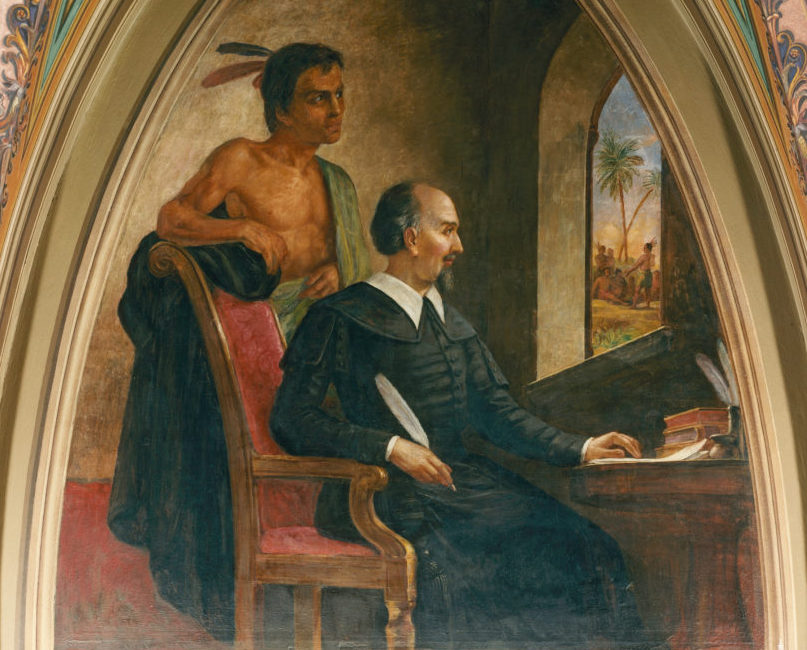
In April 1550, Charles V, Holy Roman Emperor and king of Spain, halted Spanish conquests in the Americas. He needed to know if such conquests were lawful. He had scruples; could they be overcome?
A panel of over a dozen theologians, officials and administrators gathered in the Colegio de San Gregorio in Valladolid to hear the opposing arguments. The two disputants were humanist scholar Juan Ginés de Sepúlvedra and Dominican friar Bartolomé de Las Casas. Both agreed that evangelism, the spread of Christian truth, was the goal; the question was, was war and subjugation a just means to expedite that end.
The debate opened on 15 August 1550, the feast of the Assumption, with a three-hour oration from Sepúlvedra. He drew on Aristotle to argue that the indigenous peoples of America were ‘natural slaves’, incapable of self government, and it was Spain’s moral duty to wage war on them, as a prelude to subjugation and Christianisation. “They are as inferior to the Spaniards as children to adults, women to men… [almost] as monkeys to men,” he wrote. Yes, they were skilled, but did that make them fully human? “Some small animals, both birds and spiders, make things which no human industry can imitate completely.”
Las Casas was recently returned from nearly 50 years in the Americas where, latterly, he had been
Bishop of Chiapas. An outspoken critic of Spanish cruelty, he had been known to refuse last rites to those who fell short of his standards. He began his response to Sepúlvedra the following day. Five days later he was still talking. The panel adjourned, wearily requesting a summary of his case.
Las Casas thought Christianisation should proceed peacefully, through the work of missionaries. He refuted the idea that these peoples lacked either civilisation or humanity with extensive reference to his own experience. He went so far as to defend the practice of human sacrifice, widely seen by the Spanish as proof of native barbarism, if not outright evil. “Nor is human sacrifice – even of the innocent, when it is done for the welfare of the entire state – so contrary to natural reason that it must be immediately detested,” Las Casas wrote. Sacrifice, particularly self-sacrifice – offering up “the greatest and most valuable good, that is, human life” – was a mark of religious feeling, not irrationality. Besides, war and slavery were greater evils still. Had not the Spanish themselves, in antiquity, sacrificed captives? And did not God command Abraham to sacrifice his son?
Did the debate change minds? Probably not. A second session followed in 1551, and at least one judge didn’t deliver his opinion until 1557. Conquests and cruelty continued. But still, it marks a watershed, a point at which we can see the shape of modern questions about rights and duties.
In 1573, Phillip II issued a new ordinance regulating all future discoveries by land or sea. The word ‘conquest’ was forbidden; use ‘pacification’ instead, it suggested. In its own way, that was a modern solution to the problem too.
This is an extended version of a piece that first appeared in the August 2023 issue of History Today.
Like this? You can read more of Mathew’s History Today Months Past pieces here.
 Mathew Lyons
Leave a comment