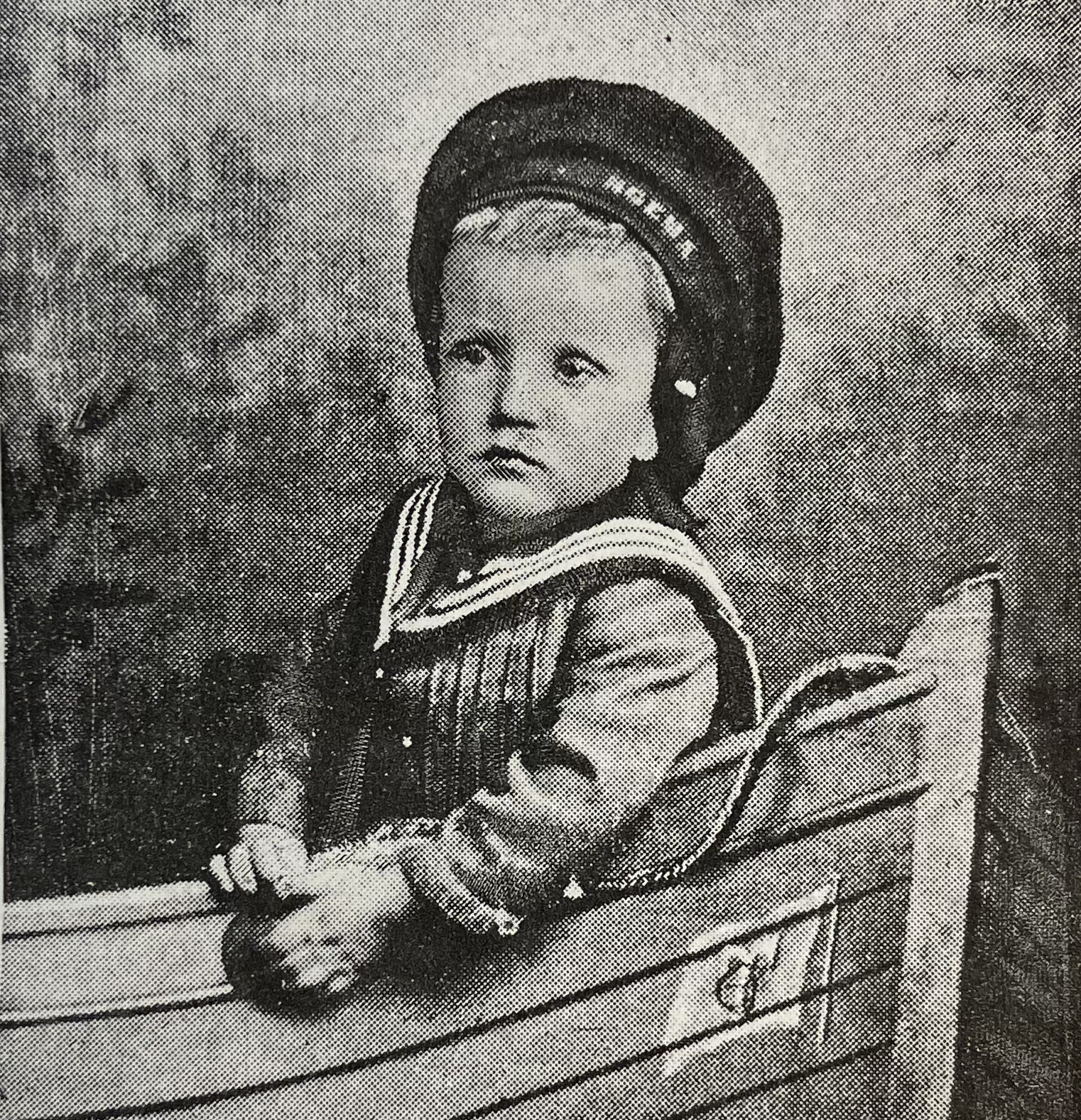

“What more pleasing to a Christian parent whose heart yearns over his children… [than] to see them thus engaged in the best of all causes, even the extension of the Redeemer’s kingdom,” wrote the Methodist Joseph Blake in The Day of Small Things, his 1849 tract encouraging the promotion of missionary zeal to the youngest of children.
Few Victorian children can have exemplified Blake’s ideals more than John Edward Hore – ‘Little Jack, the boy missionary’, as he was later called. Jack was just three months old when he first set sail with his mother Annie from London for Zanzibar in May 1882 alongside 21 other missionaries.
They aimed to join Jack’s father, Edward Coode Hore, a master mariner employed as a scientific adviser to the London Missionary Society on its mission to Lake Tanganyika. As part of his work Hore spent two years building a 54-foot, 14-ton steam yacht named The Good News; he also collected molluscs.
It was some 830 miles west from the coast to Ujiji, their destination on the eastern shores of the lake. Edward was determined that wheeled transport be involved; a previous attempt on his part to make the journey using bullock carts had failed when all the bullocks were killed by tsetse flies. “If he could succeed in getting no other vehicle,” he told a public meeting beforehand, “he would at least take his wife to Ujiji in a wheelbarrow.”
In fact, Annie was conveyed in a different wheeled vehicle, as attested to by the unimprovable title of her memoir To Lake Tanganyika in a Bath Chair – although in practice she was carried most, if not all, of the way. Jack, who suffered from a series of fevers for much of the 90-day trek, was carried too: he was in the body of an old pram rigged out like a palanquin.
For most of their time in Africa, they lived on Kavala Island, on the western edge of the lake. Jack’s “fearless friendship [with the local children] and intimate knowledge of their language made him a useful medium of teaching”, his father said. He spoke “seriously and affectionately” to them, a Christian newspaper later wrote, “of the good Father in Heaven, and the Lord Jesus who died to save them from their sins”.
Both his parents were passionately, devoutly opposed to the slave trade. Annie had been shocked to see “dark objects lying on, or beside the path” on their trek inland, which she soon realised were the bodies of those who died on the Arab slave caravans that passed through the area. “At one time the shores [of Tanganyika] were thickly populated,” she wrote, “but for the most part the lake countries have been over-run and much depopulated; ‘worked out’ the slave-trader would say.” Yet they were on good terms with – and sometimes dependent for security on – Tippu Tib, the wealthiest and most successful slave trader in East Africa.
They could see too the damage that was being done to local peoples and cultures. “Foreign adventurers have sown the seeds of… strife, and are now vigorously maintaining it,” Annie wrote. “With plausible bait of trade, and apparent local prosperity, they seek to hid the murder and rapine which is going on all around.”
Edward’s goal had been “to demonstrate the reasonableness of Europeans entering and dwelling in Central Africa”, but his own book, Tanganyika: Eleven Years in Central Africa, published in 1892, concludes with a sense that the battle was to be fought not so much against “heathenish ignorance” as “civilised immorality”. They were honest and perceptive enough to recognise how destructive the advent of industrial modernity was to the peoples and cultures of the region, but not quite so self-aware as to see their role in it.
Jack survived a bout with smallpox in the spring of 1887 and soon after the family began planning their return. They returned in the autumn of 1888; Jack, it was said, knew few words of English. On 5 April the following year he died, aged seven, from an attack of the measles.
He was interred at Highgate Cemetery, his coffin wrapped in an Arab cloth gifted to him by one of the Arab slave traders. A plaque commemorating his life can still be seen in the colonnade in the cemetery’s western half; it was paid for by subscriptions from just the sort of Sunday schools that Joseph Blake championed.
This is an extended version of a brief piece that first appeared in the April 2024 issue of History Today.
 Mathew Lyons