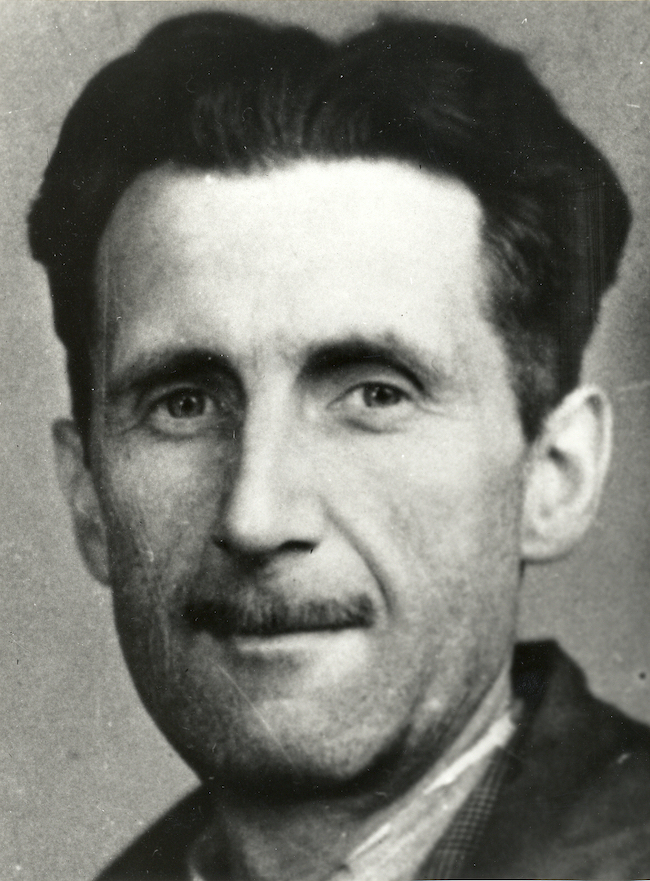
His first published work, a poem, appeared in the autumn of 1914. ‘Awake! Young Men of England’ was a patriotic rallying cry for a beleaguered nation at war. He was 11 years old and his name was Eric Blair.
He took up the pen-name George Orwell in 1932 for his first book. (Other names considered included PS Burton and H Lewis Allways.) But his prep-school days stayed with him. Orwell, said Cyril Connolly, a schoolmate and life-long friend was “a rebel in love with 1910”. Other friends saw deeper roots still: to the Trotskyite Julian Symons, he was “an Edwardian, even a Victorian figure”; to Stephen Spender, he was “traditional in a way which goes back… before industrialism, to the English village”.
Looking back on school in a long, vituperative essay called ‘Such, Such Were the Joys’, written in the 1940s, Orwell remembered it as a system in which “to survive, or at least to preserve any kind of independence was essentially criminal”. A sense of beleaguered individualism colours much of his fiction. John Flory, the central character in Burmese Days, is oppressed by imperialism; it makes him “live inwardly, secretly, in books and secret thoughts that could not be uttered”. Gordon Comstock in Keep the Aspidistra Flying is oppressed by capitalism: he “declared war on money; but secretly, of course”.
What makes Winston Smith’s oppression in Nineteen Eighty-Four different is that under totalitarianism, there is no place for privacy anymore. Orwell’s working title for Nineteen Eighty-Four, published on 8 June 1949, was ‘The Last Man in Europe’ – beleaguered isolation indeed.
Nineteen Eighty-Four was intended as a kind of rallying cry for individual liberty. Orwell didn’t understand early readers who found the book suffocatingly bleak. It was a satire, he said; its message was, “Don’t let it happen. It depends on you”. His faith in ‘the common man’ ran deep. Gordon Comstock eulogises ordinary people, in whom “greed and fear are mysteriously transmuted into something nobler”, and who retained “their standards, their inviolable points of honour”.
“If there is hope,” Winston Smith writes, “it lies in the proles.” Young men of England, awake.
This is an extended version of a brief piece that first appeared in History Today in June 2024.
 Mathew Lyons
Leave a comment