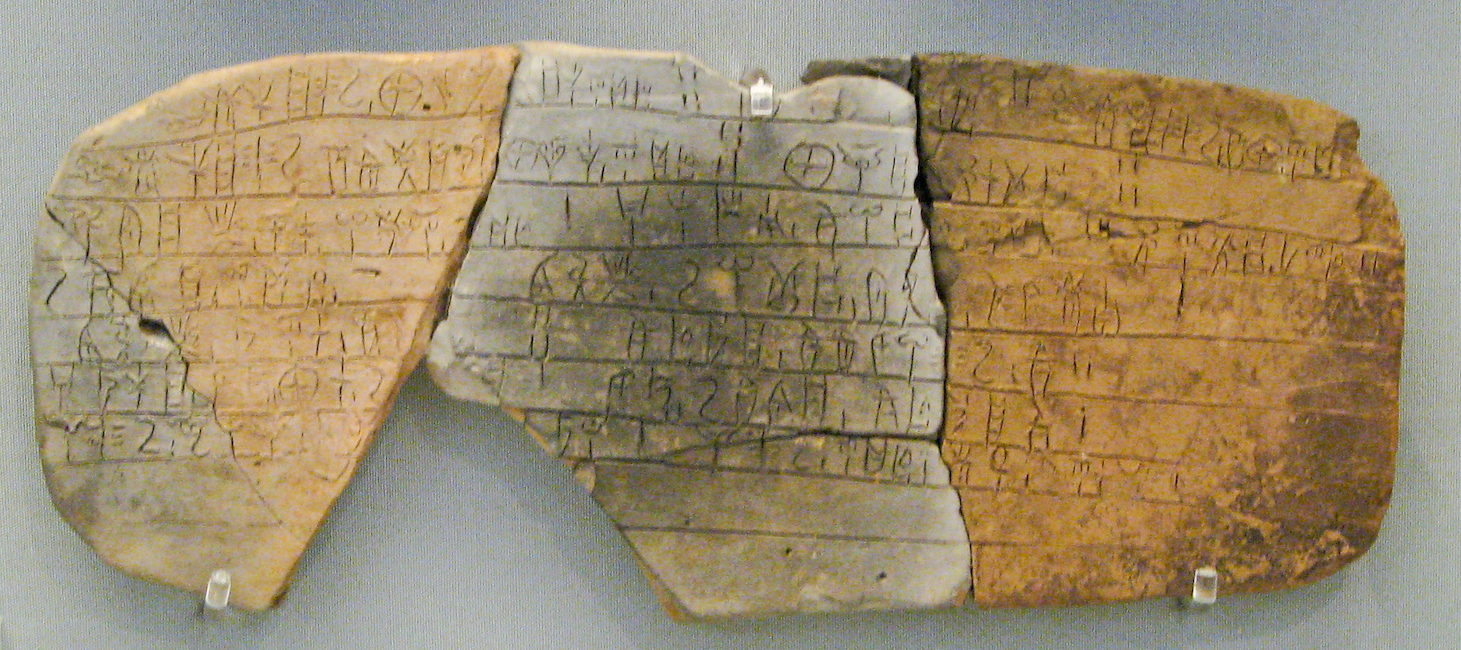
“Did you say the tablets haven’t been deciphered, sir?” The question came from the youngest member of a party of schoolboys on a tour of the Minoan Room at the Royal Academy of Arts, in 1936. The man being addressed was Sir Arthur Evans, then 85. The boy was 14 and his name was Michael Ventris.
Evans had excavated the palace complex of Knossos and uncovered the material remains of Minoan Crete at the turn of the century. He was looking for evidence of writing; he found it just a week into his dig. There were in fact three seemingly sequential archaic writing systems on Crete. The first, hieroglyphics dated from c2000BC to 1650BC. the second, which Evans named Linear A, from c1750BC to 1450BC. That too was superseded by Linear B, of which there are vastly more examples.
Evans believed the scripts and the culture to be anything but Greek: he posited an unknown ‘Eteocretan’ or ‘Anatolian’ language. So strongly did a consensus form around this that those who dissented suffered for their heresy: the Cambridge archaeologist Alan Wace was refused permission to dig in Greece for years as a result.
Ventris joined the RAF during the war and then trained as an architect. But his schoolboy obsession with deciphering Linear B remained. “It is,” he wrote, “rather like doing a crossword puzzle on which the positions of the black squares have not been printed for you.”
One problem, he said, was that “disgracefully few of the inscriptions were made generally available for study”. The fault for that lay with Evans. The first volume of his Scripta Minoa, largely dedicated to hierogplyhs, was published in 1909. The second didn’t arrive for another 43 years, by which time Evans had been dead for eleven years.
Despite all the dead ends, the path to the decipherment was paved with the work of others, notably the American Alice Kober, who noticed patterns in Linear B suggestive of inflection. Which is to say, the presence of words in which the root remains constant but the ending changes according to grammatical context. “The words will be seen as it were to wag their tails,” the philologist Leonard Palmer explained in these pages, “and can be arranged in tail-wagging classes.”
Ventris’ great intuitive leap was to apply this idea to place names. He had spotted that the specific patterns which Kober had identified were entirely absent from a large new tranche of Linear B tablets, discovered at Pylos in 1939. Suddenly, out of the opaque and unreadable past, emerged recognisable forms of ‘Knossos’ and its nearby harbour town, ‘Amnisos’.
Over the years, scholars had attempted to fit Linear B to everything from Hebrew and Sumerian to Finnish and Basque. Ventris himself expected to find Etruscan. Ventris: “The theory that the Minoans could be Greek is based of course upon a complete disregard for historical plausibility,” he had confidently written. And yet, to his astonishment, Greek it was – albeit a thousand years older than the language of Plato.
Just weeks after the breakthrough, on 1 July 1953, Ventris was invited to talk about Linear B on the BBC’s Third Programme. The Times quickly dubbed it ‘the Everest of Greek Archaeology’. But the broadcast was the first most scholars in the field knew of it. The proof “came as an electrifying shock to almost all those who studied the question,” the philologist John Chadwick wrote. Ventris was sympathetic: “It obviously hit a bit hard for an old man to be told that Greek had been sitting under his nose for 40 to 50 years without his suspecting it.”
Chadwick himself used the proof to reveal the names of Athena, Poseidon and Apollo on a single tablet. It seemed too good to be true, but it wasn’t. He joined forces with Ventris – Watson to the latter’s Holmes, he said – to uncover the secrets of what they called Mycenaean Greek.
As with other early writing systems, Linear B revealed a kind of audit trail of livestock, crops and manufactured goods, of trades, people and places. Hopes of finding pre-Homeric poetry amongst the palace accounts, or indeed elsewhere, have been disappointed. Writing begins in economics and commerce; art comes limping in their wake. But is there not music in the ordinary stuff of life born again from the dried clay?
Michael Ventris was killed a car crash, aged 34, in 1956. The following year a tablet was found at Pylos with a routine list on one side and, on the reverse, a drawing of a labyrinth. It recalls of course, the legendary labyrinth of King Minos at Knossos. But it also seems a good metaphor for decipherment and its revelations, its slow and daring journey into the unknown.
This is an extended version of a brief piece that first appeared in History Today in July 2024.
 Mathew Lyons
Leave a comment