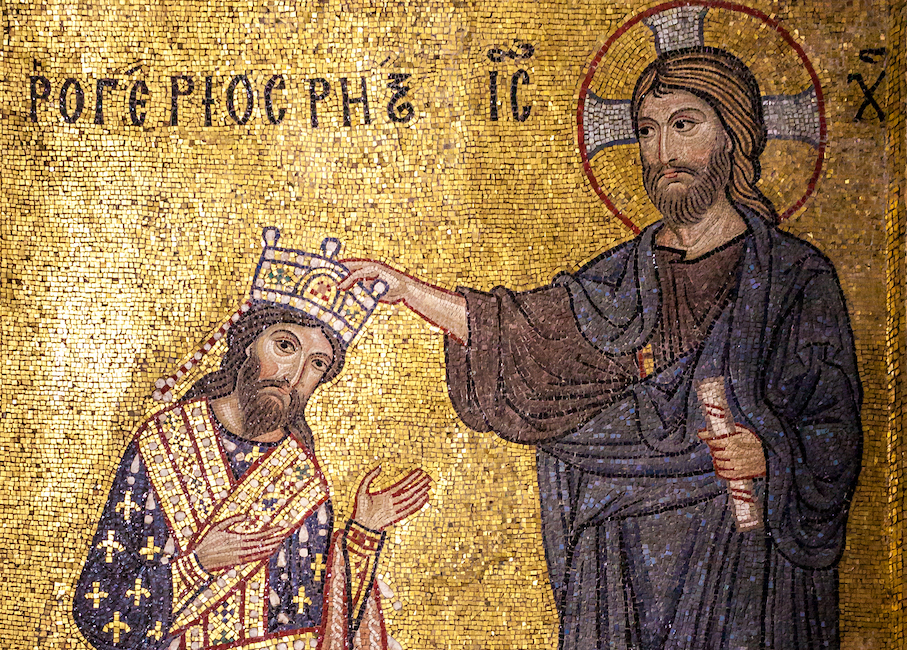
It has been said that Roger II, self-styled Rex Siciliae et Italiae, conceived of his kingdom as a “work of art”. Perhaps he did. But if so, contemporary reviews were mixed at best. To Bernard of Clairvaux he was “the Sicilian usurper”; to the Byzantine Theodore Prodromos he was the “tyrant of a small toparchy of apes”; to a Saxon chronicler he was “a semi-pagan”.
Why the hostility? It was, in a way, a coup. The title of king was granted to Roger by the pope, if not under duress then certainly under pressure. The papacy was in schism. One claimant, Innocent II, had the support of the Holy Roman Empire. The other, Anacletus II, had the city of Rome itself, but little else. A crown must have seemed a small price to pay to a man with an army and most of southern Italy at his feet, and the papal declaration of 27 September 1130, following a meeting between the two at Benevento, more or less acknowledged the realpolitik. “Divine providence,” it noted, had “granted [Roger] greater wisdom and power than the rest of the Italian princes.” One can almost hear the papal sigh.
In some ways, Roger’s critics were right: the kingdom was, by medieval European standards, an absurdity. His father and uncle were Norman adventurers who had seized large parts of southern Italy – including Apulia and Calabria, the last Byzantine territories in the west, and the Islamic emirate of Sicily – towards the end of the previous century. But Roger himself didn’t even always lead his men into battle.
Often it seemed like the whole of Christendom opposed him. The papacy did so whenever it dared. Likewise both the Holy Roman and the Byzantine empires. Venice and Genoa declared war. And yet, Roger expanded into Africa, conquering a stretch of coast from Tripoli to Cape Bon, and inland as far as Kairoun. For a while he styled himself King of Africa, too.
Moreover, while he might have been a Latin ruler, Roger spoke both Greek and Arabic, and preferred the former where possible. His army was mostly Muslim. His court was tri-lingual: Greeks and Muslims dominated, as they did in Sicily as a whole. His chief official, George of Antioch, was a Byzantine who had served under the Islamic Zirid dynasty in what is now Tunisia. Crusading fever was breaking across Europe, but Sicily was a multi-faith, multi-ethnic oasis of tolerance.
The Arab geographer Al’ Idrisi thought Palermo “the greatest and finest metropolis in the world”. Perhaps the kingdom wasn’t so much a work of art as a magic trick.
This is an extended version of a brief piece that first appeared in the September 2024 issue of History Today.
 Mathew Lyons
Leave a comment