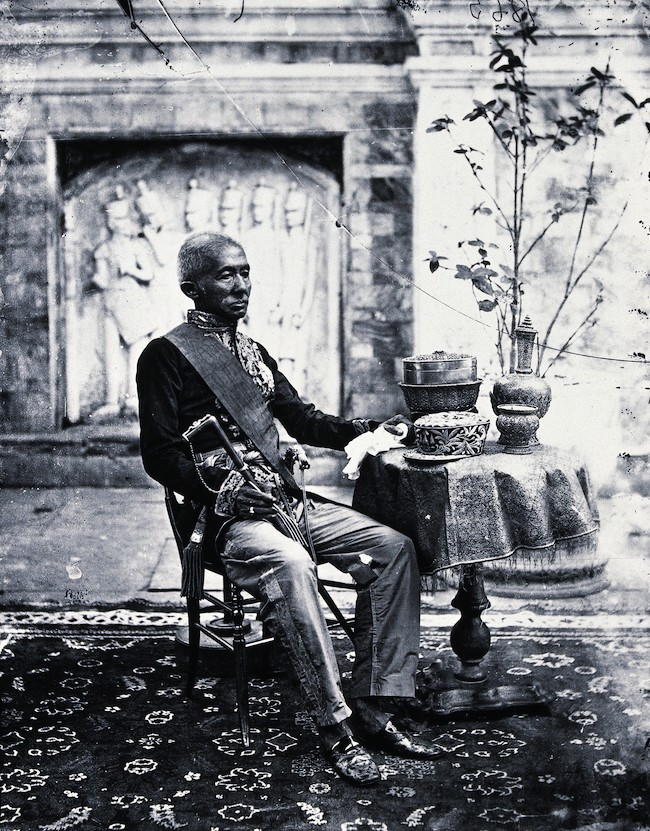
When his father, Rama II, died in 1824, the Siamese throne was taken by Mongkut’s older half-brother, who ruled as Rama III. Mongkut himself, aged 19, joined a monastery. This wasn’t unusual: three months as a monk was customary. Mongkut stayed for twenty-seven years, becoming known as Mongkut the Beggar.
While in orders Mongkut spearheaded a new, reformist religious movement which aimed to strip away later accretions to the Buddha’s teachings; he mocked the dominant older order, the Mahanikai, as the Order of Long-Standing Habit.
How fortunate was it that in 1833, on pilgrimage to the ancient capital of Sukhothai, Mongkut found a stele, dated to 1292, which describes the simpler judicial, religious and other customs of perhaps the first Thai kingdom and its king Ram Khamhaeng.
But when Mongkut became king himself in 1851, the punctilious recourse to historic virtues was only one card in his hand. China had recently been humbled by the British in the Second Opium Wars and Siam was turning uneasily westward. “There will be no more wars with Vietnam and Burma,” Rama III, Mongkut’s predecessor, said on his deathbed. “We will have them only with the West.”
Mongkut was fascinated by western materialism and industry, but disdainful of the missionary pieties that came with it. He offered modernity a cautious yes; but edicts were issued, as they always had been, “by royal command reverberating like the roar of a lion”. But did the British respect his caution? The diplomat Sir John Bowring came in 1855 with a particular mix of etiquette and belligerence. Bowring had a “large fleet at [his] disposal”, he told Mongkut, but he had no desire to be “the bearer of a menacing message”. It was not so much gunboat diplomacy as gunboat globalisation.
Nevertheless, by the end of the 19th century, Siam alone would remain free of imperial dominion in the region, despite the subjugation of Indonesia, Malaysia, Burma, Indochina and the Philippines. It helped that Mongkut played imperial powers against one another: agreements similar, if not identical, to the one signed with the British, were quickly signed with a host of countries including the United States, France, Denmark, Portugal, the Netherlands, Prussia and the Hanseatic Republic.
Mongkut himself knew Latin and English, speaking the latter fluently “but with a literary tinge”, as if he had acquired it all from books. He relaxed by reading and writing. He studied science and maths. Astronomy was a particular passion: he liked its ability to accurately describe and predict. His private apartments, Bowring said, were like “the study or library of any opulent philosopher in Europe” being filled with instruments and appliances – thermometers, clocks, barometers and such.
In a way, western science was the death of him. In August 1868 he led an expedition to the south of the country to view an eclipse, the arrival of which he had predicted himself using the Copernican method. The eclipse duly arrived, but Mongkut caught malaria. On 1 October 1868, realising that he was dying, Mongkut asked to be turned on to his right side, as the Buddha had been on his death bed. “This is the correct way to die,” he said, precise to the end.
This is an extended version of a post that first appeared in the October 2024 issue of History Today.
 Mathew Lyons
Leave a comment