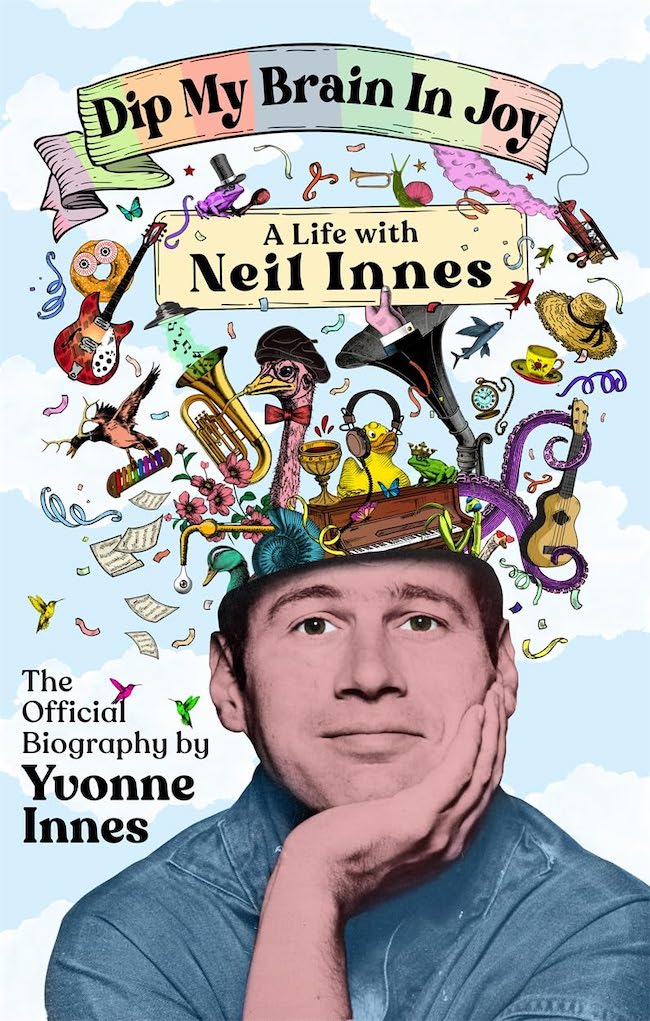
Fans of that beloved British cultural institution Doctor Who are wont to talk about ‘their’ Doctor – that is, which iteration of the character was their entry-point to the franchise. The same might be said of fans of the no-less beloved songwriter, musician and comedian Neil Innes, who died in 2019 aged 75.
In the 1960s, Innes was a key member of the exhilaratingly unpredictable The Bonzo Dog (Doo Dah) Band, whose blend of verbal, musical and visual humour remains matchless in its absurdity, breadth and daring. Innes was the band’s de facto musical director, or, as he described it, the “misery guts who kept saying lets’s all play the same chords at least eighty per cent of the time”, a policy some Bonzos found dictatorial. More than that, he and fellow songwriter Vivian Stanshall became the Lennon and McCartney of a generation of awkward kids who looked askance at the grown-up world and took comfort in laughing at it instead.
In the 1980s, another generation of outsiders discovered Innes through The Raggy Dolls, an animated series for children, for which he performed all the voices and wrote every episode – as well as the theme song. It followed the adventures of a group of mis-shapen dolls who found themselves in the reject bin.
Others will know Innes from his work as a member of the Monty Python team, primarily when they performed live in the 1970s. He went on to form a close working relationship with Eric Idle. The two worked together on the cult Rutland Weekend Television, which itself spawned the glorious All You Need is Cash, a film about The Rutles, a parody of The Beatles, for which Innes wrote some twenty songs. Then there were three series of The Innes Book of Records for the BBC, in which Innes performed his own songs while playing multiple different characters.
But, as his widow Yvonne Innes reveals in Dip My Brain in Joy, her moving memoir of their life together, Innes was in many ways a retiring man, emotionally ill-adapted to the sharp-elbowed, teflon-hearted world of showbiz. He was born into an army family in 1944, and, perhaps because of that early peripatetic life, his instinct socially was to fit in. He picked up and unconsciously mirrored mannerisms and accents within moments of meeting people, which is perhaps a clue to his talent for affectionate yet razor-sharp parody. A calming presence in any situation, he was also pathologically averse to confrontation. Instead, he soothed away his sorrows and frustrations with copious wine and industrial-strength cigarettes.
Innes was stubbornly protective of his creative work, but hated dealing with managers and the business side of his profession. The aversion probably cost him dearly. The Rutles soundtrack was nominated for a Grammy. Rightly so: it is a masterpiece, packed with some of Innes’s best songs, all powerfully evocative of The Beatles while always sounding fresh and joyously themselves. But ATV, the music publisher which then owned the rights to The Beatles catalogue, sued and Innes’s own publisher capitulated. The Innes Book of Records was never repeated or commercially released by the BBC due to contractual problems. What turned out to be his last album, Nearly Really, was successfully crowdfunded – only for the crowdfunding platform to go bankrupt and swallow almost all of the money.
And then there is Eric Idle. It isn’t entirely clear why they fell out. But when Innes was approached to revive The Rutles for an album to accompany and parody The Beatles’ Anthology project in the mid 1990s – an approach that, rarely for Innes, came with the promise of a good promotional budget – Idle stalled the project by suing over the rights to the band name, which he owned. The album did eventually limp out, but the timing, and the budget, were gone. “You’re supposed to be sending us up,” George Harrison, a mutual friend, said, “not emulating us.”
Then Innes’s writing royalties for Spamalot, the musical based on Monty Python and the Holy Grail, for which he co-wrote some songs, mysteriously dried up despite the show’s apparent international success. And he was devastated not to be invited to take part in the Monty Python stage reunion in 2014. That snub – if it was a snub – is laid at Idle’s door too. It is not clear how fair this is to Idle, but there’s no doubting how Innes felt about it. “It was unfortunate that, over time, all sorts of spats caused them both a lot of hurt,” Yvonne writes diplomatically, “and, in Neil’s case, a lot of financial hardship.”
Dip My Brain in Joy is positioned as the official biography. That is a shame – partly because it is much more a memoir of Yvonne’s marriage to Neil than it is a biography, and partly because Innes was a fascinating man, a sublimely gifted parodist, and a writer of wistful, memorable songs that balanced with with with deep, often melancholy, feeling. Very few people combine humour and pathos so effectively – Cleese compares him to Chaplin – and he and his work merit a more thorough account than is offered here.
In the last two decades of Innes’s life, Yvonne often acted as his factotum on tour and elsewhere, “a band sometimes made up of just me and Neil happily passing through this lifetime, finding where we belonged”, she writes, a description which fits them well. They met in 1962 and married in 1966; pangs of loss recur throughout. “There seemed to be years of youngness ahead of us,” she writes poignantly at one point, and her grief still seems livid and raw. In a couple of passages she slips into the present tense, as if the unthinkable has still yet to happen. The last sections of the book, on Innes’s sudden death one night and its aftermath, are painful to read.
It is hard not to share her grief. Innes comes across as a good and charming man who lived a good, charmed life steeped in love. His approach to living – “Not to say ‘no’ when there is a way to say ‘yes’” – has much to commend it. Tensions within the marriage surface occasionally, money worries are constant, and Yvonne herself has fleeting troubles with her mental health; but their long marriage appears both strong and indelibly happy. Creating happiness seems to have been one of Innes’s gifts, in public and in private.
“We decided to go back to where the nice people were and enjoy what we’d got,” Yvonne writes after yet another setback. “And so, I like to think, we won that way.” On this reading, they really did.
This is an extended version of a review that first appeared in The Spectator.
 Mathew Lyons