In the last days of 1835 the explorer Robert Schomburgk stood on the shores of Lake Amucu in western central Guiana. In April, the surrounding savannah would be inundated by the rising tides of two nearby river systems creating the illusion of a great body of water; but now, in December, the waters were low.... Continue Reading →
Camillo Agrippa and the Renaissance art of fencing
When change came, it was swift. Until the turn of the 1570s, Edmund Howes writes in his continuation of John Stow’s Annales, “the auncient English fight of sword and buckler was onely had in use”. Bucklers – small shields – were to be bought in any haberdasher. But “shortly after… began long rapiers, and he... Continue Reading →
The rise and fall of the Sistine Chapel castrati
Eunuchs had sung for centuries in the Byzantine church, but it isn’t until the 1550s that records of castrati begin to appear in western Europe. The first known to enter the Sistine Chapel choir was a Spaniard in 1562; Sixtus V authorised their recruitment for St Peter’s in a bull of 1589. By the end... Continue Reading →
The death of Atahualpa, the last emperor of the Incas
In the late afternoon of 26 July 1533, Atahualpa, last true emperor of the Incas, was led out into the public square of Cajamarca a city in the Andean highlands, now in northern Peru. His conquistador captors, led by Francisco Pizarro, had just decided he must die. During the nine months or so of his... Continue Reading →
News: Not Just The Tudors
A few weeks ago I had the great pleasure and privilege of talking about the Dissolution of the Monasteries to Suzannah Lipscomb for her fantastic new podcast series #NotJustTheTudors. Do have a listen! The link is here.
Songhay: the rise and fall of Africa’s greatest empire
The Songhay Empire wouldn’t be the first military power to set too much store in its cavalry. But by the time it fell to Morocco at the end of the sixteenth century it had little cause for complacency about anything. Founded in 1464 out of the ruins of the Malian Empire, Songhay was the largest... Continue Reading →
Leo Africanus: the Muslim historian who taught Renaissance Europe about Africa
For the first English translation of his most influential work, The Description of Africa, he is John Leo. His baptismal name was Joannes Leone de Medici, although he preferred its Arabic form, Yuhannah al-Asad. His birth name was al-Hasan Ibn Muhammad Ibn Ahmad al-Wazzan. But he is best known as Leo Africanus. His date of... Continue Reading →
Radical terror, the Tailor-King and the Anabaptists of Munster
The spire of the church of St Lambert in Münster has three unusual adornments: cages. They were first hung on 22 January 1536 to hold the mutilated bodies of Jan Bockelson, Bernard Krechting and Bernhard Knipperdolling, surviving leaders of the Anabaptist sect which had controlled the city for sixteen months. Anabaptism had emerged in the... Continue Reading →
Hans Holbein: The Artist in a Changing World by Jeanne Nuechterlein
In Augsburg’s Staatsgalerie Altdeutsche Meister there is a three-paneled painting illustrating the life of St Paul, painted by local artist Hans Holbein the Elder in 1504. Commissioned for the city’s Dominican convent of St Katherine, it includes, in its left panel, a self-portrait of the artist with his two sons, Hans and Ambrosius – nicknamed,... Continue Reading →
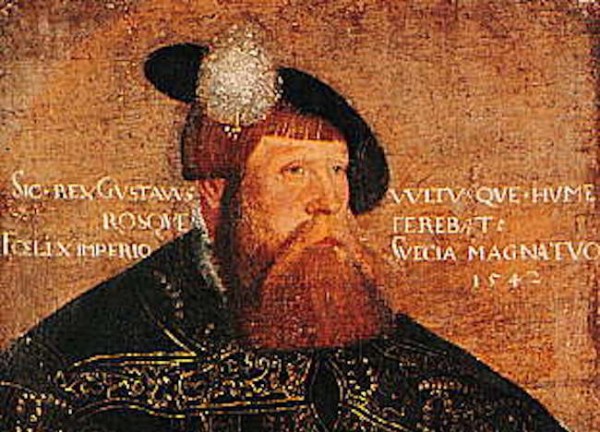
Gustav Vasa, the Stockholm Bloodbath and the end of a European union
A decades-long union of European countries is supported by the respective national elites; but its destruction comes through the ruthless exploitation of popular nationalism by an autocratic leader. Does that sound familiar? It is, of course, the Kalmar Union between Denmark, Norway and Sweden, which saw the three kingdoms being governed under a single monarch... Continue Reading →
Nicholas Hilliard: Life of an Artist by Elizabeth Goldring
It is July 1571, and Elizabeth I is sitting for a portrait in “the open ally of a goodly garden”, almost certainly at Hampton Court. The portrait is “in little” – what we would now call a watercolour miniature, although the latter term didn’t enter the English language until Sir Philip Sidney introduced it from... Continue Reading →
Thomas Churchyard: Pen, Sword & Ego by Matthew Woodcock
If, as every self-help book will tell you, persistence really were the key to success, Thomas Churchyard would surely have been the most successful writer of the sixteenth century. Reader, he was not – but it was not for want of trying. One measure of Churchyard’s distant familiarity with fame is that Matthew Woodcock’s Thomas... Continue Reading →
Henry Fitzroy – the forgotten Tudor prince
Henry Fitzroy was born in the summer of 1519 – almost certainly in June – at the small Augustinian Priory of St Laurence at Blackmore in Essex. His mother was Elizabeth Blount, herself not yet 20, who came from minor Shropshire gentry. Elizabeth had entered service as one of Catherine of Aragon’s maids of honour... Continue Reading →
Sir Walter Ralegh and the search for El Dorado
Map of Guiana by Hessel Gerritsz, 1625. El Dorado is at the western end of Lake Parime Not many people have the distinction of putting a non-existent place on the map, but Sir Walter Ralegh was one of them. That place was El Dorado, a legendary city of gold located in what is now Venezuela.... Continue Reading →
Summer’s Last Will and Testament by Thomas Nashe
Saturday 30 September saw a unique staging of Thomas Nashe’s only extant whole-authored play, Summer’s Last Will and Testament, in the Great Hall of the Bishop’s Palace in Croydon, where it was first performed in the early autumn of 1592. The performance was a joint venture between the Edward’s Boys company, from the King... Continue Reading →
Mary, Countess of Pembroke: poetry, patronage and power
This is, more or less, the text of the talk I gave earlier this month at the Wilton History Festival. Mary, Countess of Pembroke, and her sons William and Philip, were the most influential patrons of the Elizabethan and Jacobean era. Let’s begin with a story to illustrate that assertion. For the moment, we will... Continue Reading →
Of God and Jonson: theatre history, new things and non-events
I was fortunate to be able to attend some of the superb Before Shakespeare conference at Roehampton last week. I came away with a range of thoughts and ideas, some of which I hope to pursue in one form or another. Perhaps the thing that struck me most, however, was Bill Ingram’s opening talk. Ingram... Continue Reading →
So High A Blood: The Life of Margaret, Countess of Lennox by Morgan Ring
So High A Blood explores in detail the life of Margaret, Countess of Lennox, a Tudor princess without whom, perhaps, there would have been no Stewart succession and no subsequent union between England and Scotland. Born in 1515, Margaret was the daughter of Margaret Tudor, the eldest daughter of Henry VII, by her second husband... Continue Reading →
Shakespeare in London by Hannah Crawforth, Sarah Dustagheer and Jennifer Young
The world might be forgiven for rolling its eyes at the prospect of another book on Shakespeare. Does Shakespeare in London, the latest addition to the Bloomsbury Arden list, have anything new to say? The answer is a confident yes. Shakespeare in London is a short book with big ambitions. It weaves together various narratives... Continue Reading →
The Black Prince of Florence: The Life of Alessandro de’ Medici by Catherine Fletcher
Alessandro de’ Medici reigned from 1532 to 1537 as the first duke of one of Italy’s greatest city-states. Yet just as he lived in obscurity until his teens in the late 1520s, he has largely been returned to that obscurity by historians ever since. Why then, asks Catherine Fletcher, has her subject been so ill-served... Continue Reading →