The year before Mary Wollstonecraft wrote A Vindication of the Rights of Woman, another writer, Olympe de Gouges, published a comparable call for equality during the turmoil of revolutionary France. De Gouges’ Déclaration des droits de la femme et de la citoyenne, published in September 1791, was a direct response to the Déclaration des droits... Continue Reading →
Hans Holbein: The Artist in a Changing World by Jeanne Nuechterlein
In Augsburg’s Staatsgalerie Altdeutsche Meister there is a three-paneled painting illustrating the life of St Paul, painted by local artist Hans Holbein the Elder in 1504. Commissioned for the city’s Dominican convent of St Katherine, it includes, in its left panel, a self-portrait of the artist with his two sons, Hans and Ambrosius – nicknamed,... Continue Reading →
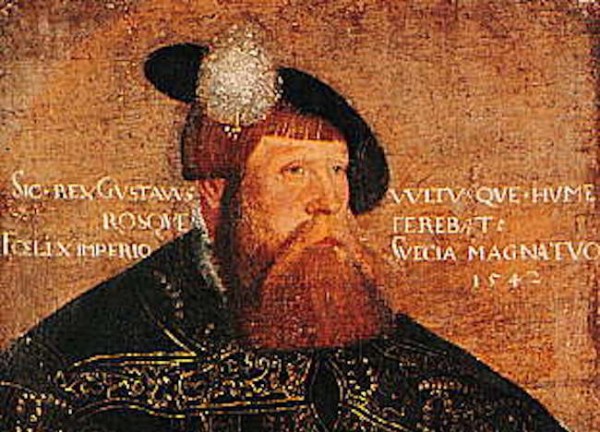
Gustav Vasa, the Stockholm Bloodbath and the end of a European union
A decades-long union of European countries is supported by the respective national elites; but its destruction comes through the ruthless exploitation of popular nationalism by an autocratic leader. Does that sound familiar? It is, of course, the Kalmar Union between Denmark, Norway and Sweden, which saw the three kingdoms being governed under a single monarch... Continue Reading →
Nicholas Hilliard: Life of an Artist by Elizabeth Goldring
It is July 1571, and Elizabeth I is sitting for a portrait in “the open ally of a goodly garden”, almost certainly at Hampton Court. The portrait is “in little” – what we would now call a watercolour miniature, although the latter term didn’t enter the English language until Sir Philip Sidney introduced it from... Continue Reading →
The Black Prince of Florence: The Life of Alessandro de’ Medici by Catherine Fletcher
Alessandro de’ Medici reigned from 1532 to 1537 as the first duke of one of Italy’s greatest city-states. Yet just as he lived in obscurity until his teens in the late 1520s, he has largely been returned to that obscurity by historians ever since. Why then, asks Catherine Fletcher, has her subject been so ill-served... Continue Reading →
The Grotian moment: Hugo Grotius and the invention of international law
A lawyer serving a life sentence escapes from prison hidden in a bookcase: as a plot point it would have the sort of ironic neatness that gives novelists and screenwriters a bad name. In this instance, however, it is true. It happened on 22 March 1621. The prison was the 14th Century castle of Loevestein,... Continue Reading →