The visions began when Hildegard of Bingen was young – perhaps as young as three. But unlike many mystical religious experiences, the visions did not come in dreams or ecstatic states; ecstasy, she thought, was a defect. They came like a cloud of light inside her on which forms and shadows moved while her eyes... Continue Reading →
Ahilyabai Holkar: a philosopher queen remembered
Ahilyabai Holkar, queen of the Malwa kingdom in north-west central India, part of the Maratha empire, died on 13 August 1795, having reigned for nearly thirty years. She came to power in 1767 after the deaths of her father in law, Malhar Rao Holkar, and her young, sickly son. (Her husband had died in battle... Continue Reading →
Hans Holbein: The Artist in a Changing World by Jeanne Nuechterlein
In Augsburg’s Staatsgalerie Altdeutsche Meister there is a three-paneled painting illustrating the life of St Paul, painted by local artist Hans Holbein the Elder in 1504. Commissioned for the city’s Dominican convent of St Katherine, it includes, in its left panel, a self-portrait of the artist with his two sons, Hans and Ambrosius – nicknamed,... Continue Reading →
When graduates voted twice
With support for the EU significantly higher among those with a university education, it’s interesting to recall that well into the 20th century graduates could vote twice in UK general elections: once in their local constituencies and again through their universities, which at one point held fourteen seats between them. The idea that universities should... Continue Reading →
Manuela Sáenz: the Liberator’s saviour
On the night of September 25 1828, a small group of armed men approached the presidential palace in Bogotá. Inside, Simón Bolívar lay in bed asleep beside his mistress, Manuela Sáenz. Bolívar – known as El Liberator – had led large parts of South America to freedom from imperial Spain, but his increasingly autocratic, anti-republican... Continue Reading →
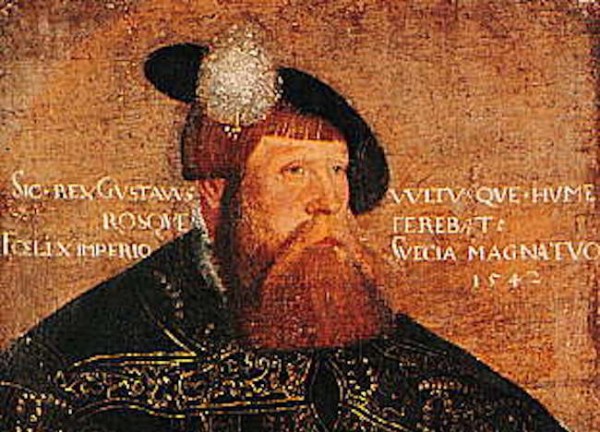
Gustav Vasa, the Stockholm Bloodbath and the end of a European union
A decades-long union of European countries is supported by the respective national elites; but its destruction comes through the ruthless exploitation of popular nationalism by an autocratic leader. Does that sound familiar? It is, of course, the Kalmar Union between Denmark, Norway and Sweden, which saw the three kingdoms being governed under a single monarch... Continue Reading →
The Life and Death of Colonel Blimp: the film Churchill tried to kill
It’s 10 September 1942. The German army is at Stalingrad. Bomber Command is sending 479 planes to bomb Düsseldorf. And Winston Churchill is writing to Brendan Bracken, his Minister of Information, about a British film already in production. “[P]ropose to me the measures necessary to stop this foolish production before it gets any further,” he... Continue Reading →
The pioneering archaeologist Dorothy Garrod
On 6 May 1939 the pioneering archaeologist Dorothy Garrod was elected to the Disney chair of archaeology at Cambridge. She was the first woman to be a professor at either Oxford or Cambridge; women were still not admitted to full degrees at the university – despite having been educated there since 1869. Her election brought... Continue Reading →
From Africa to Canterbury: the first remaking of the English church
Five of the first six archbishops of Canterbury to be consecrated were not native to this country. None came from as far afield as the seventh: Theodore, born in 602, was a Greek-speaking monk from Tarsus – the modern Turkish city of Gözlü Kule – in what was then a Byzantine province. Educated in Antioch... Continue Reading →
The Matter of Song in Early Modern England by Katherine R Larson
A couple of years ago I was lucky enough to hear legendary English folk singer Shirley Collins perform. One of the songs she sang was ‘Awake, Awake’, written by Thomas Deloney in 1580 but seemingly forgotten until Ralph Vaughan Williams heard it sung by an elderly Herefordshire woman in July 1909. Long dead on the... Continue Reading →
Nicholas Hilliard: Life of an Artist by Elizabeth Goldring
It is July 1571, and Elizabeth I is sitting for a portrait in “the open ally of a goodly garden”, almost certainly at Hampton Court. The portrait is “in little” – what we would now call a watercolour miniature, although the latter term didn’t enter the English language until Sir Philip Sidney introduced it from... Continue Reading →
Birds in the Ancient World by Jeremy Mynott
Pity the wryneck – a species of long-tongued woodpecker – in ancient Greece: it had the great misfortune to be considered an essential part of a sex toy. The poor bird was spread-eagled and bound to the four spokes of a wheel, which, when spun, whistled in a way thought sure to arouse desire in... Continue Reading →
Between fact and fiction
This article first appeared in the January 2016 issue of History Today. What does it mean to write history today? What claims can historians make about their work? These are just two of the questions that sprang to mind after listening to Niall Ferguson tussle with the Pulitzer Prize-winning novelist Jane Smiley on Radio 4’s Start... Continue Reading →
Young academics: the great betrayal
This piece first appeared in the September 2015 issue of History Today. I discussed the issues it raised with Catherine Fletcher in a related podcast which can be heard here. Catherine wrote a THE blog in response to my article and the disagreements it aroused, which can be read here. Supporters of the status quo... Continue Reading →
Shakespeare in London by Hannah Crawforth, Sarah Dustagheer and Jennifer Young
The world might be forgiven for rolling its eyes at the prospect of another book on Shakespeare. Does Shakespeare in London, the latest addition to the Bloomsbury Arden list, have anything new to say? The answer is a confident yes. Shakespeare in London is a short book with big ambitions. It weaves together various narratives... Continue Reading →
Taking history out into the world
My eyes were caught the other week by a news story in Haaretz, the Israeli newspaper, which reported an interview with the Iranian foreign minister, Mohammad Javad Zarif. Defending his country against accusations of anti-semitism, Zarif cited, among other things, the role of Cyrus the Great, who led Persia in the mid-sixth century BC, in... Continue Reading →
Charlie Hebdo and the judgement of history
As I write this, millions of people are on the streets of France to protest about the murders of eight writers and artists at Charlie Hebdo, of four Jewish patrons of a kosher food store, and of three police officers. Much comment in the media has identified the slaughter in Manichean terms, reflecting a battle... Continue Reading →
Herodotus, Camden and the reclamation of history
I have recently been reading Tom Holland’s superb new translation of Herodotus’ Histories. I am by no means an authority on classical writers, but I have always enjoyed Herodotus. He is so irrepressibly inquisitive and, in every sense, a pleasure to read. Holland has always been a fine writer, both in the clarity and subtlety... Continue Reading →
Shakespeare, the Blackfriars and the theatre of experience
It has always bemused me that there is so little formal – or, for that matter, informal – dialogue and collaboration between historians and literary scholars. Each are aware of the others’ work, certainly; but the intellectual, cultural and administrative inheritances that maintain the academic silos of schools and faculties surely seem increasingly outdated in... Continue Reading →
Lost in translation
We are all familiar with the opening life of LP Hartley’s 1953 novel The Go-Between: “The past is a foreign country. They do things differently there.” Like all elegantly expressed truths it quickly became a cliché. And, as such, like all clichés, it obscures as much as it reveals. It is difficult not to look... Continue Reading →