On Barnes Common in West London, one midnight in the early days of 1955, a policeman approached four men sitting in a parked car. They were wearing velvet-collared jackets, stovepipe trousers, bootlace ties and crepe-soled shoes. ‘Teddy Boys’, he thought to himself. “Now then you lot,” he told them. “Get weaving before I pinch you.”... Continue Reading →
The Archpriest Avvakum and the Third Rome that wasn’t
The Archpriest Avvakum Petrov spent the last fourteen years of his life in a pit in Pustozersk, high above the Arctic Circle. Born around 1620 in a small village in Nizhny Novgorod, he had become a leading figure among the Old Believers in the schism that split the Russian church in the 17th century. Patriarch... Continue Reading →
Love and death: the revolutionary art of José Guadalupe Posada
Artist José Guadalupe Posada was born on 2 February 1852 in the city of Aguascalientes in central Mexico. Biographical details are scant. He produced over 20,000 engravings across his career, first using lithography, then wood- and metal-cuts, and finally relief etching, a technique most associated with William Blake. But when he died in January 1913,... Continue Reading →
Drowned soldiers and headless cattle: the Finnish Club War of 1596
Sweden was on a war-footing constantly in the last decades of the sixteenth century. Taxes fell disproportionately on the peasantry, who in Finland – still under Swedish dominion – also had to accept the billeting of troops in the villages. Soldiers were allowed to take whatever they wanted from village stocks of food and fodder.... Continue Reading →
Motherlands: In Search of Our Inherited Cities by Amaryllis Gacioppo; Exiles: Three Island Journeys by William Atkins
In 1688 a 19-year-old medical student from Berne named Johannes Hofer observed a condition that medicine had yet to define. Symptoms of this ‘melancholy delirium’ might include fever, disturbed sleep, palpitations, loss of appetite and anxiety – sometimes ultimately leading to death. Hofer noted the case of a fellow student from Berne, now living in... Continue Reading →
The Grunwick dispute: workers’ rights, street violence and ‘the Ascot of the left’
“It was a long hot summer.” Thus Lord Scarman begun his account of the small dispute at Grunwick, a film-processing company in north-west London, which escalated into one of the defining industrial conflicts of the late 1970s. The dispute began with the sacking of a young worker, Devshi Bhudia, for slow work on Friday 20th... Continue Reading →
The first defenestration of Prague
The defenestration of three Catholics from the high windows of the castle in Prague in May 1618 helped precipitate the Thirty Years War. But it wasn’t the first time the people of Bohemia had resorted to this distinctive method of extra-judicial killing. On the first occasion, two centuries earlier, the proximate causes were the same:... Continue Reading →
The killing of Jean-Paul Marat by Charlotte Corday
She had planned to kill him in public. But the summer of 1793 in Paris was exceptionally hot and Jean-Paul Marat’s painful skin condition - a form of psoriatic arthritis - required him to spend long periods in his bath at home in the Rue des Cordeliers. It was there, around 7pm on the evening... Continue Reading →
A Murderous Midsummer: The Western Rising of 1549 by Mark Stoyle
On September 8, 1549, the 11-year-old Edward VI stood on the roof of the Palace of Westminster and looked down on ten bedraggled, weary West Country men, made to stand where he might see them. A few short weeks before they had led a rebellion that exploded out of Devon and Cornwall and threatened to... Continue Reading →
The Siege of Loyalty House by Jessie Childs
“There is nothing that doth more advance and sour a man’s misery”, the eulogist said at the funeral of Sir Marmaduke Rawdon in April 1646, “than this one thought and apprehension: that he was once happy.” Before the outbreak of the English civil war, Rawdon had been a highly successful merchant in London; his unofficial... Continue Reading →
The discovery of Parkinson’s Disease
At 10am on 7 October 1794 a 39-year-old physician named James Parkinson presented himself in Whitehall for interrogation by William Pitt and the Privy Council. They were investigating what became known as the Popgun Plot, an alleged attempt to assassinate George III. Parkinson, a member of the radical London Corresponding Society, knew some of those... Continue Reading →
‘A Socialist Romance’: Edith Lanchester and the perils of over-education
By the autumn of 1895, Edith Lanchester was 24. Born into a prosperous middle-class family, she had studied at London University and Birkbeck and was earning her own living as a clerk at the Cardiff (New South Wales) Gold Mining Company. She was also was already a seasoned socialist campaigner whose ringing voice, it was... Continue Reading →
Radical terror, the Tailor-King and the Anabaptists of Munster
The spire of the church of St Lambert in Münster has three unusual adornments: cages. They were first hung on 22 January 1536 to hold the mutilated bodies of Jan Bockelson, Bernard Krechting and Bernhard Knipperdolling, surviving leaders of the Anabaptist sect which had controlled the city for sixteen months. Anabaptism had emerged in the... Continue Reading →
The French Revolution and the execution of Olympe de Gouges
The year before Mary Wollstonecraft wrote A Vindication of the Rights of Woman, another writer, Olympe de Gouges, published a comparable call for equality during the turmoil of revolutionary France. De Gouges’ Déclaration des droits de la femme et de la citoyenne, published in September 1791, was a direct response to the Déclaration des droits... Continue Reading →
Liberty, mysticism and blood: Nat Turner’s slave revolt of 1831
Nat Turner was born into slavery on a Virginia plantation, on 2 October 1800. Convinced from an early age that he was a prophet, Turner taught himself to read and write. His spiritual path mirrors that of other mystics: he maintained an austere life apart from the wider community; he fasted and prayed; he sought... Continue Reading →
Manuela Sáenz: the Liberator’s saviour
On the night of September 25 1828, a small group of armed men approached the presidential palace in Bogotá. Inside, Simón Bolívar lay in bed asleep beside his mistress, Manuela Sáenz. Bolívar – known as El Liberator – had led large parts of South America to freedom from imperial Spain, but his increasingly autocratic, anti-republican... Continue Reading →
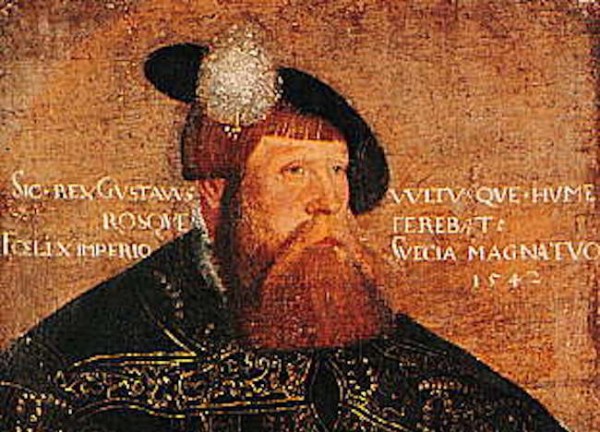
Gustav Vasa, the Stockholm Bloodbath and the end of a European union
A decades-long union of European countries is supported by the respective national elites; but its destruction comes through the ruthless exploitation of popular nationalism by an autocratic leader. Does that sound familiar? It is, of course, the Kalmar Union between Denmark, Norway and Sweden, which saw the three kingdoms being governed under a single monarch... Continue Reading →
God’s Traitors: Terror and Faith in Elizabethan England by Jessie Childs
The daily lives of catholics in England under Elizabeth I and James I have long been neglected by historians. True, much as been written about the various attempts against Elizabeth during her reign – most obviously the Babington ‘complotment’ which resulted in the execution of Mary, Queen of Scots – and, of course, the Gunpowder... Continue Reading →
The Dutch Church: the dissolution and its tragic aftermath
It is convenient for historians to conceive of history in neat discrete categories, but all too often that approach both obscures continuities and suggests that events are less brutally random than they are. There are, for instance, many ways of writing about the influence of the English Reformation and the dissolution of the monasteries on... Continue Reading →
Sir Walter Ralegh and the Babington plot
I was not, truth be told, expecting to write much, if at all, about the world of espionage when I first set out to research The Favourite, my recent book about the relationship between Elizabeth I and Ralegh. After all, Ralegh’s protestant credentials in the fight against imperial Spain would appear, at first sight, unimpeachable.... Continue Reading →