When the connoisseur Gerrit Braancamp died in 1771, the auction of his collection was one of Amsterdam’s events of the year. Some twenty thousand people saw it; two thousand copies of the catalogue were sold. The two most valuable paintings – a triptych by Gerard Dou known as ‘The Nursery’ and ‘Large Drove of Oxen’... Continue Reading →
Beowulf: Poem, Poet and Hero by Heather O’Donoghue

Beowulf is a poem steeped in mystery and otherness. It survives in only one manuscript, the Nowell Codex, named for its owner in the 16th century. The manuscript itself was fortunate to survive a fire that engulfed the library that housed it in 1731. Its edges are still charred and flaky: that’s how close it... Continue Reading →
The crusade against the pagan north: Livonian Knights, the frozen Baltic and the Battle of Karuse

It wasn’t exactly a motto, but they liked it nonetheless. “The sword is our Pope,” the Livonian Knights said, “and it is a Pope that is never far from you.” Formerly known the Sword Brothers, the Livonian Knights were a military monastic order akin to the Knights Templar. They were founded around 1202 to bring... Continue Reading →
Drowned soldiers and headless cattle: the Finnish Club War of 1596

Sweden was on a war-footing constantly in the last decades of the sixteenth century. Taxes fell disproportionately on the peasantry, who in Finland – still under Swedish dominion – also had to accept the billeting of troops in the villages. Soldiers were allowed to take whatever they wanted from village stocks of food and fodder.... Continue Reading →
The Kyivan queens of medieval Europe

Ukraine has been part of European history since before the Norman Conquest. Indeed, in the middle of the 11th century, the queens of Norway, Hungary, France and Poland were all Kievan Rus’ princesses. The first three were daughters of Yaroslav, grand prince of Kyiv and Ingegerd Olofsdotter of Sweden. The fourth was Yaroslav’s sister, Maria.... Continue Reading →
Blood on the altar: the Viking raid on Lindisfarne

The northern diaspora we call the age of the Vikings is testament to the mobility of early medieval Europe. So too is the fact that the most contemporary account we have of the viking raid on Lindisfarne of 8 June 793 comes from the court of Charlemagne in faraway Aachen. Alcuin, a Northumbrian monk and... Continue Reading →
Gustav Vasa, the Stockholm Bloodbath and the end of a European union
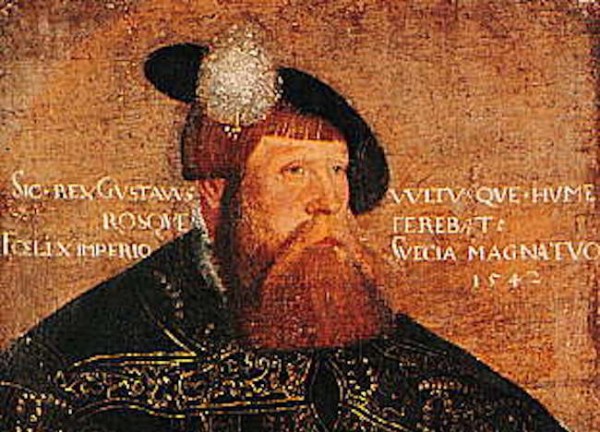
A decades-long union of European countries is supported by the respective national elites; but its destruction comes through the ruthless exploitation of popular nationalism by an autocratic leader. Does that sound familiar? It is, of course, the Kalmar Union between Denmark, Norway and Sweden, which saw the three kingdoms being governed under a single monarch... Continue Reading →
 Mathew Lyons