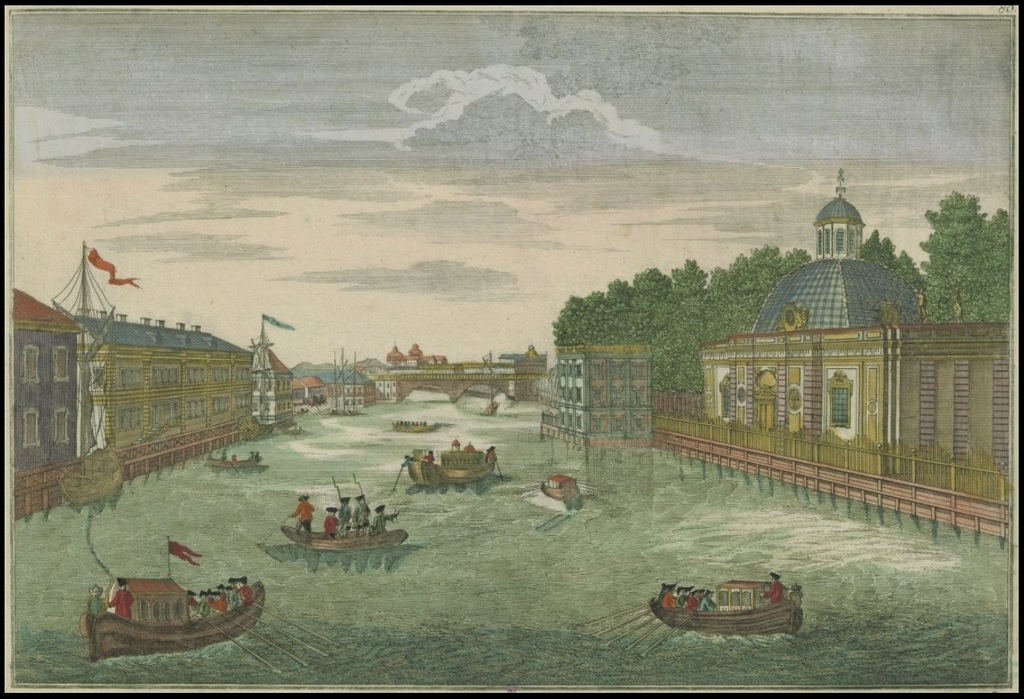
Elizabeth Justice was surely not alone in being young and unhappily married in 18th-century London. Where she was singular, however, was in how she responded to her circumstance. She insisted on separating from her husband, Henry Justice, after he “struck her such a blow on the head that it swelled much”. Then, when he persistently refused to pay the annuity they had agreed, she found herself a job – in, of all places, St Petersburg.
Others might have balked at the challenge, but Justice was insouciant. “I left England to sail three thousand miles with only a splendid-shilling in my pocket… [and] without the least anxiety,” she wrote home to a friend. She spent three years as governess to an English merchant family in the newly-built city, an experience she wrote about in her memoir Voyage to Russia, published in 1739, three years after her return. It is the first book of travel writing by a woman to be published in English.
Hers is a vivid portrait of life on the periphery of a courtly elite adapting to western fashions: French gowns, twice-weekly Italian operas, the occasional Dutch play. Justice didn’t care for the latter: “I think nobody would choose to see them twice,” she sniffs. But Russian life and customs continued, and she has a sharp eye for food and drink, housing and heating, rites and rituals. And, of course, the cold: “The men’s beards look as if they were set with diamonds, by the icicles hanging about them,” she writes of a winter scene. “The green trees are become so white, that they put me in mind of the rosemary upon cakes at twelfth-tide.”
Justice wrote another book, a novel, published in 1751: Amelia, or The Distress’d Wife: A History. But another line on the title page reveals the truth: ““Founded on Real Circumstances”. It is her life story; and, insofar as anyone can now tell, barely fictionalised at all. Her father, Dorset Surby, becomes Amelia’s Dorset Sanby, for example.
It is perhaps ironic that she turned to writing as a source of income, since the root of her unhappiness was her husband’s bibliomania. “Let him have ever so much money in the house,” she wrote in Amelia, “he would not part with it, without it was in pursuit of a book or books that pleased him.” Prints were a particular passion. “I have seen him kiss a fine print, as he called it, for half an hour together,” she said.
It was more than bibliomania, though. In 1736, her husband was found guilty of stealing books from the libraries of Cambridge University. Sixty titles were specified at trial, but there is evidence the theft extended to some four wagon-loads. Sentenced to transportation for seven years to the America plantations, he eventually settled in Holland. When he died in 1763, he counted 7,798 books in his library. How many were stolen is unknown.
Justice herself, worn out by ill-health and financial struggle, died aged 49 on 15 March 1752. “Every body loves me,” she had Amelia write to a friend, “but he that should.”
This is an extended version of a piece that first appeared in the March 2023 issue of History Today.
Like this? You can read more of Mathew’s History Today Months Past pieces here.
 Mathew Lyons
Leave a comment