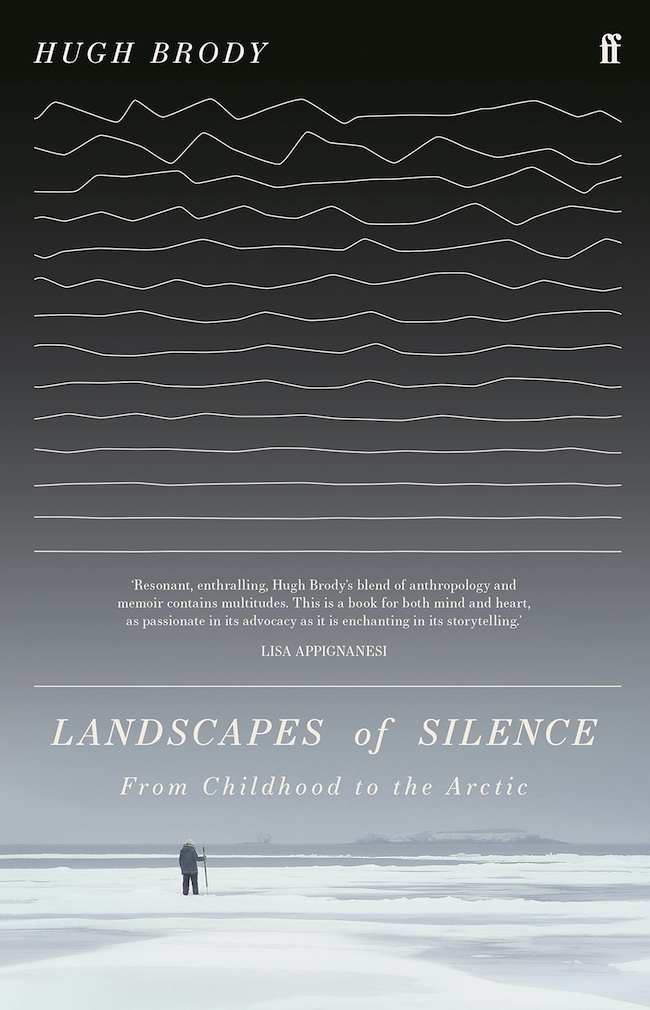
One night in the winter of 1961–2, the anthropologist Hugh Brody sat on the bed in his attic room in his parents’ house, placed a cartridge in his shotgun, leaned the shotgun barrel against his head and pulled the trigger. ‘My sense of having no future was so complete that it obscured the possibility of there being a present,’ he writes of that moment now. He was eighteen years old.
What made a boy whose childhood loves were bucolic – countryside, birds, fishing – and creative (painting was another passion) become so emptied of hope, so inert to the possibility of happiness? Over the first section of Landscapes of Silence – part memoir and part, in its author’s characterisation, anthropology of the self – Brody sketches a childhood dominated by a mother incapable either of expressing love or of sharing any part of her emotional life, of providing that well of intimate stories and experience that all families, however constructed, draw sustenance and solidity from. It wasn’t until the very last night of her life, in the summer of 2009, he writes, that he ever thought he loved her. He never tells us her name.
But he came to understand her trauma and empathise with her. She was a Viennese Jew from a prosperous bourgeois family. She fled Austria with her own mother shortly before the war. Working as a nurse in a Sheffield hospital, she met and fell in love with a doctor, whom she soon married. While she was settling down and starting a family – procreation was a conscious statement of defiance against Nazism, Brody learned from letters and diaries after her death – her own extended family was being murdered in the camps and elsewhere. She never talked about what or whom she lost, or about her grief; indeed, she barely acknowledged its existence. She sublimated her pain into an obsessive dedication to assimilation, to belonging, to silencing herself, to effacing her history and identity. What the young Brody experienced from her was anger. “Her need for order… would cause her to strike out at me, with threats and sometimes with violence,” he writes. “I felt the shock of this… the shock of love becoming an attack on me.” The memories are still plainly raw, her silence an open wound.
The damage Brody’s mother did was compounded by his grandmother, who countered her daughter’s silence with night-time whisperings to her barely school-age grandson of what it meant to be Jewish. ‘You could never escape,’ she told him. There was, he understood, ‘pain everywhere for people like me’, even though he had ‘suffered no pain, had lost no one’. This apparent paradox was impossible for the young boy to resolve. ‘To grasp what was being told I would have had to know it all already,’ he writes. In some ways, his childhood experiences anticipated questions that he would face in his anthropological work: is it possible to understand a culture, a way of being, without having experience of it from the inside?
The eighteen-year-old Brody was lucky. His gun misfired. A local gamekeeper mended it the following day, but the crisis had passed. Brody went on, ultimately, to have a long and distinguished career in anthropology, which he characterises as ‘the profession of other places’. But it was a visit to a Druze village on the Lebanese border with Israel, made while he was working on a kibbutz, that woke in him an attraction to societies far distant from his own and far distant from the centres of power – to places and peoples beyond the margins of the West. It was only later in life that he realised how well his chosen calling fitted his need to escape what he calls, in a terrifying phrase, ‘the home that hunts us down’.
The place where he came closest to happiness was the Arctic, which he first visited in 1970 and where he lived for some years among the Inuit, returning often. Among that people, and through the warmth and generosity of their welcome, Brody felt himself at home for the first time. ‘I was given this sense of belonging,’ he writes. ‘A flood of both anthropology and delight.’ Later, as abuses of the Inuit came to light, Brody wondered what it said about himself, about his cultural blindnesses, that he missed these crimes. Was there ‘something more personal that led to my myopia’, he asks himself. One teacher whom Brody knew was sentenced to eleven years in prison for sexually abusing young boys; as of 2015 152 victims had been identified.
The Inuit, Brody writes, are reluctant to describe experiences that are not their own; they consider it disrespectful and inappropriate. And yet, when he learned Inuktitut, the Inuit language, Brody was specifically asked to do just that: to translate the needs and perspectives of the Inuit for a Western audience, for those who were, one way or another, invading their territories and degrading their cultural identities. The landscapes of the book’s title are both political and emotional, and the fractured relationships between language and silence, language and experience, language and identity, keep surfacing throughout this fragmentary but powerful and evocative work. Landscapes of Silence is a remarkable, often uncomfortable exploration of difficult terrains in which the author’s pain and the damage done to indigenous peoples are likewise livid and raw.
This review first appeared in the July 2022 issue of Literary Review.
Read more of Mathew’s reviews here.


Great review. Book sound fascinating! Xx
>